Avoid Breaches: 5 Vendor Checks for Hosting Health Data in Australia
For Australian health providers: legal steps to host health data onshore, why My Health Record requires it, a checklist of five vendor checks, and a...

Yes. If your organisation touches My Health Record data, onshore hosting isn’t optional under Section 77 of the My Health Records Act, and for every other kind of health information, keeping it in Australia is the safest way to meet the Australian Privacy Principles. Your first move isn’t picking a vendor. It’s mapping exactly where your health data lives right now, including backups and any offshore replication you didn’t know was happening.
TL;DR:
- Hosting of My Health Record data must occur exclusively onshore under Section 77 to ensure compliance, with offshore storage risking legal violations.
- Mapping all current data locations, including backups and offshore copies, is essential before selecting or contracting a hosting vendor.
- Security measures for compliant hosting should include patching, multi-factor authentication, restricted admin privileges, and tested backups, with encryption at rest and in transit being critical.
- Procurement should focus on specific agreements covering data residency, subcontractors, breach response, technical support, and exit strategies, rather than relying on certification badges alone.
- Moving clinical data into a private cloud hosted within Australia helps meet legal requirements and simplifies compliance management.
Table of Contents
- What health data hosting in Australia actually means
- The legal framework that actually shapes your options
- Security controls a compliant host should already have
- The vendor checklist compliance teams actually need
- A practical migration path with minimum risk
- Where an Australia-hosted private cloud fits the picture
- Where to check the official rules yourself
- Why the compliance conversation usually starts in the wrong place
- Sources
- FAQ
What health data hosting in Australia actually means
Under the Privacy Act 1988, anything collected while providing a health service counts as health information, a category of sensitive information that carries stricter handling rules than ordinary personal data. That includes Medicare numbers, diagnostic notes, imaging, and even a patient’s stated wishes about future treatment. It’s not just clinical records. A booking confirmation that mentions a specific procedure is health information too.
Once you accept that classification, the hosting model you choose stops being a purely technical decision. Australian providers generally work with one of these:
- On-premises servers — full physical control, but you own every patch, backup, and failover.
- Australia-hosted private cloud — dedicated infrastructure inside Australian data centres, often with contractual data residency guarantees.
- Sovereign hosting — a stricter variant where ownership, support staff, and administrative access all stay within Australia.
- Australian public-cloud regions — major providers’ local zones, useful for scale but requiring careful contract review.
- Offshore SaaS — frequently used for non-clinical tools, but risky for anything touching My Health Record or identifiable patient records.
Practice management systems and imaging archives usually sit on private cloud or sovereign hosting. Backups and integration engines are where offshore leakage most often creeps in unnoticed.
The legal framework that actually shapes your options
Three pieces of legislation do the heavy lifting here, and they don’t always align neatly.
The Privacy Act 1988 requires health service providers to treat health information as sensitive and apply extra protection. The OAIC’s Guide to health privacy spells out what “reasonable steps” looks like in practice: an up-to-date privacy policy, a documented map of where personal information is held, and a tested data breach response plan. If you disclose information to an overseas recipient, you remain accountable for how that recipient handles it, so due diligence on offshore subprocessors isn’t optional just because the breach happens on someone else’s server.
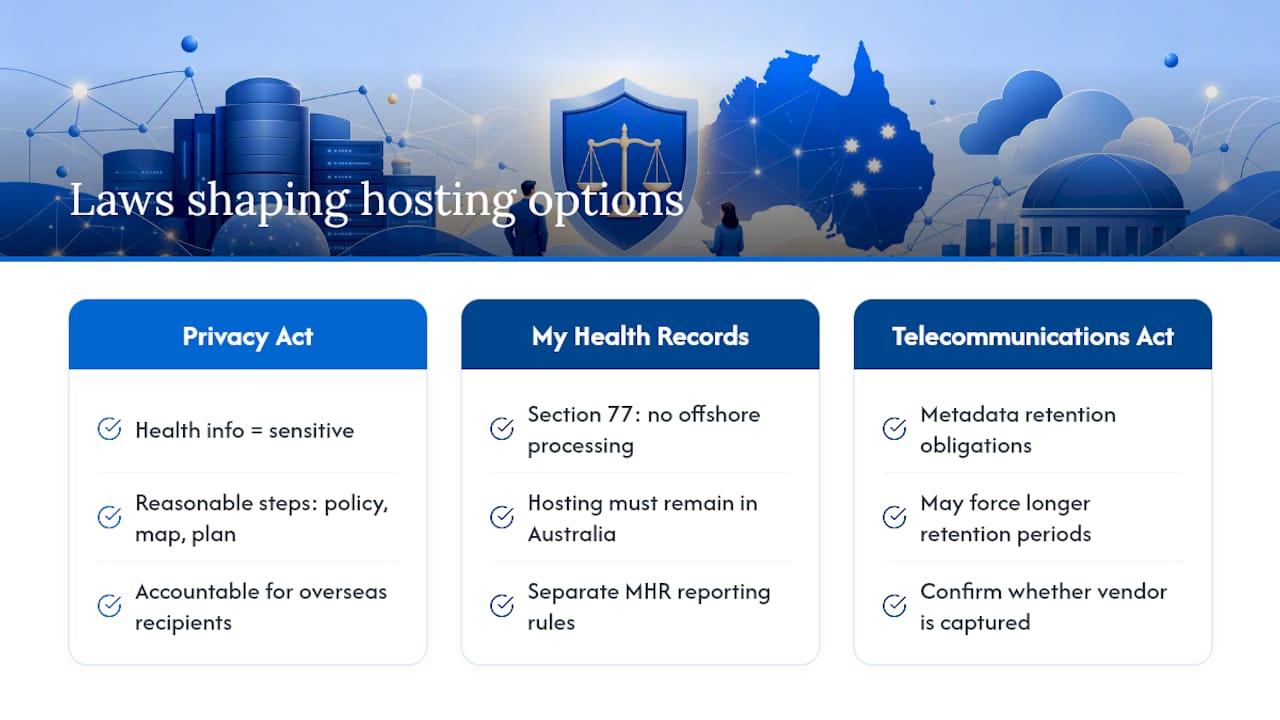
The My Health Records Act goes further. Section 77 prohibits holding or processing certain My Health Record system data overseas, full stop. This is a hard boundary, not a preference, and it flows straight through to your vendor contracts: any system touching My Health Record integration needs a hosting arrangement that never leaves Australian soil.
Then there’s the Telecommunications (Interception and Access) Act. Some hosting or communications providers are captured by data retention obligations requiring metadata retention for a legally specified period. It’s worth confirming with any vendor whether their service falls into this category, because it changes what they’re legally required to keep and for how long.
Breach notification isn’t a maybe. Both the Notifiable Data Breaches scheme and the My Health Record system carry their own reporting obligations, and the clock on notification starts the moment you become aware of a likely breach, not when you’ve finished investigating it.
Security controls a compliant host should already have
Once residency is sorted, security posture is the next filter. The Essential Eight from the Australian Cyber Security Centre gives you a baseline that maps cleanly onto hosted health services:
- Patching cadence for applications and operating systems, applied on a defined schedule, not “when we get to it.”
- Multi-factor authentication on every administrative and remote-access account.
- Restricted administrative privileges, so a compromised staff account can’t touch the whole environment.
- Regular backups, tested by actually restoring them, not just confirming the backup job ran.
Beyond the Essential Eight, ask about encryption at rest and in transit, and who holds the encryption keys. Onshore key management matters just as much as onshore storage. Logging and audit trails need to cover who accessed what and when, ideally feeding an intrusion detection setup someone actually monitors.
Disaster recovery deserves specific numbers, not vague reassurance: what’s the Recovery Time Objective, the Recovery Point Objective, and where do the offsite backups actually sit? “Offsite” and “offshore” are not the same thing, and a lazy contract can blur them.
Pro Tip: Ask for the certification’s scope document, not just the logo. An ISO 27001 or SOC 2 certificate can cover a narrow slice of infrastructure while leaving the actual application layer untested. Read the statement of applicability before you trust the badge. A private cloud architecture built for APP 8 and APRA CPS 230 compliance is one way vendors demonstrate this scope clearly upfront.
The vendor checklist compliance teams actually need
Procurement conversations go sideways when the questions are too general. Get specific, in this order:
- Data residency, in writing. Ask exactly where primary copies, backups, and any failover or disaster recovery sites are physically located, not just where the “primary region” is marketed as being.
- Contract terms and subprocessors. Request the data processing agreement, a full subprocessor list, and confirmation of your right to audit or inspect.
- Incident response commitments. What’s the SLA for detecting, containing, and notifying you of a breach, and is support actually staffed in Australian time zones?
- Technical integration proof. Confirm support for FHIR and HL7 for clinical data exchange, and DICOM if imaging is involved, alongside encryption and logging detail.
- Exit terms. Understand egress pricing, the format your data comes out in if you leave, and whether migration assistance is included or billed separately.
Sovereignty questions specifically deserve their own line item in any due diligence document. A structured list of data sovereignty questions can save a compliance officer hours of back-and-forth with a vendor’s sales team.
A practical migration path with minimum risk
Moving live clinical data is not a weekend project. A staged approach keeps risk manageable:
- Map and classify every data holding, flagging anything connected to My Health Record specifically, since that data has zero tolerance for offshore storage.
- Pilot before you commit. Test interoperability with your existing EMR or PMS, validating that FHIR and DICOM exports and imports actually round-trip cleanly.
- Set retention and purge rules up front, including anonymisation where it’s appropriate, and confirm where encryption keys will live.
- Operationalise governance: scheduled access reviews, logging that’s actually checked, staff training, and disaster recovery drills run on a calendar, not “eventually.”
- Rehearse your breach response before you need it. A notifiable data breach plan that’s only ever existed on paper tends to fall apart under real pressure.
Pro Tip: If you’re layering AI tools like chat or voice assistants into patient-facing workflows, treat conversation logs as temporary context, not permanent records. Storing raw AI conversation history indefinitely creates a new leak surface that your existing privacy policy probably never anticipated. Push verified outcomes into the clinical record and let the rest expire.
Where an Australia-hosted private cloud fits the picture
An Australia-hosted private cloud gives you a straightforward answer to the residency question: your data doesn’t leave the country, and you can point to that in writing during an audit. That single fact removes a lot of the ambiguity that offshore public cloud regions create around backups, telemetry, and support access.
Some conversational AI platforms run entirely on Australian infrastructure, which matters if you’re layering voice, SMS, live chat, or email agents onto patient communication. Relevant capabilities for health providers include:
- Multichannel AI agents that integrate directly with existing CRM and clinical systems via API.
- Private cloud or fully on-premises deployment for organisations that need maximum control over where data physically sits.
- Configurable data retention settings, so conversation history doesn’t linger longer than your policy allows.
- Contextual memory scoped to the interaction, rather than an unmanaged accumulation of patient conversation data.
None of that replaces your obligations under the Privacy Act or the My Health Records Act. It does mean the infrastructure layer isn’t working against you while you meet them.
Where to check the official rules yourself
Don’t take any vendor’s word for compliance claims, including ours. Go to the source. The OAIC’s health privacy guide covers operational obligations in detail. The Australian Digital Health Agency’s cloud guidance sets interoperability expectations. The Essential Eight gives you a security baseline, and Home Affairs’ TIA Act guidance clarifies retention duties.
Why the compliance conversation usually starts in the wrong place
Most guides on this topic lead with security certifications, ISO numbers, SOC 2 badges, encryption standards. Those matter, but they’re not where the real risk sits for Australian health providers. The risk sits in the gaps nobody audits: the backup job replicating to an overseas region nobody flagged, the analytics telemetry quietly leaving the country, the AI chatbot logging full conversations indefinitely because nobody set a retention limit.

The OAIC frames this correctly: privacy compliance is ongoing risk management, not a certificate you earn once. That framing gets lost when providers treat a hosting decision as a one-time procurement exercise rather than something to revisit every time a new integration, subprocessor, or AI tool enters the environment.
If you take one thing from this, make it the data map. Before you evaluate a single vendor, know exactly where every copy of your health information currently sits, including the copies you inherited from a system nobody’s touched in three years. Compliance built on an incomplete map is compliance built on guesswork, no matter how good the paperwork looks afterwards.
— Sowrabh
This article is general information, not a substitute for advice from a qualified doctor. Consult a qualified healthcare professional about your own circumstances before acting on anything here.
Sources
- The privacy act — health and medical research | OAIC
- Essential Eight | Australian Cyber Security Centre
FAQ
Does Australia have a HIPAA equivalent?
Not exactly, but the Privacy Act 1988 and its Australian Privacy Principles serve a similar function, setting rules for how health information is collected, stored, and disclosed. The My Health Records Act adds a stricter, sector-specific layer that HIPAA doesn’t directly mirror, particularly around onshore hosting requirements.
Which domain host is the best in Australia for a health provider?
There’s no single “best” host for every practice, because the right choice depends on whether you’re handling My Health Record data, imaging, or general patient records. What matters more than the brand name is confirmed Australian data residency, Essential Eight alignment, and clear contractual terms on backups and subprocessors.
Is free website hosting suitable for health data in Australia?
No. Free hosting services rarely offer the data residency guarantees, encryption controls, or audit trails that health information legally requires. They’re fine for a public-facing marketing page, but never for anything touching patient records or My Health Record integration.
Who is the largest private healthcare provider in Australia?
Ramsay Health Care is widely recognised as one of Australia’s largest private hospital operators, running facilities across the country. Provider size doesn’t change the hosting obligations though. Every organisation handling health information, large or small, faces the same Privacy Act and My Health Records Act requirements.
What happens if My Health Record data is stored overseas?
Section 77 of the My Health Records Act restricts holding or processing certain My Health Record system data outside Australia, making this a compliance breach rather than a grey area. Providers and their vendors need contractual and technical guarantees that this data, including backups, never leaves Australian soil.