Contact centre AI integration: a 2026 enterprise guide
Discover what is contact centre AI integration in our 2026 guide. Learn how AI enhances workflows and boosts customer satisfaction today.

Contact centre AI integration is defined as the embedding of artificial intelligence technologies, including natural language processing (NLP), machine learning, and conversational AI, directly into contact centre systems to automate interactions and enhance operational workflows. The industry term for this practice is “contact centre AI,” and it goes well beyond deploying a standalone chatbot. Gartner research shows that customers prioritise completing tasks over receiving mere answers, which means effective AI integration must support transactions, not just Q&A. For enterprise decision-makers and IT professionals, understanding what contact centre AI integration delivers, technically and commercially, is the starting point for any serious deployment decision.
What is contact centre AI integration and which technologies drive it?
Contact centre AI integration combines NLP, machine learning, robotic process automation (RPA), and conversational AI into a unified system that handles customer interactions across voice, SMS, email, and live chat. Each technology plays a distinct role. NLP interprets customer intent from spoken or written language. Machine learning refines responses over time based on interaction data. RPA executes back-end tasks, such as updating records or processing forms, without human input.
The distinction between a basic chatbot and an advanced AI voice agent matters enormously here. A basic chatbot matches keywords to scripted replies. An advanced AI voice agent understands context, remembers prior interactions, and completes transactional tasks such as updating account details or submitting documents. That capability gap is why enterprises are moving away from point solutions and toward integrated AI architectures.
Key capabilities that integrated AI brings to a contact centre include:
- Intelligent call routing: AI analyses caller sentiment and predicted need before routing to the right agent or automated flow.
- Real-time agent assistance: AI surfaces relevant knowledge base articles and suggested responses during live calls.
- Automated routine interactions: Common enquiries, appointment bookings, and payment confirmations run without agent involvement.
- CRM-connected context: Native CRM integration enables real-time bidirectional data flow, so AI acts on current customer data rather than stale records.
- Sentiment analysis: AI flags frustrated or high-value customers for priority escalation.
Pro Tip: When evaluating AI capabilities, test whether the system can complete a transaction end-to-end, not just answer a question. Task completion is the benchmark that separates genuine integration from a glorified FAQ engine.
What business benefits does contact centre AI integration deliver?
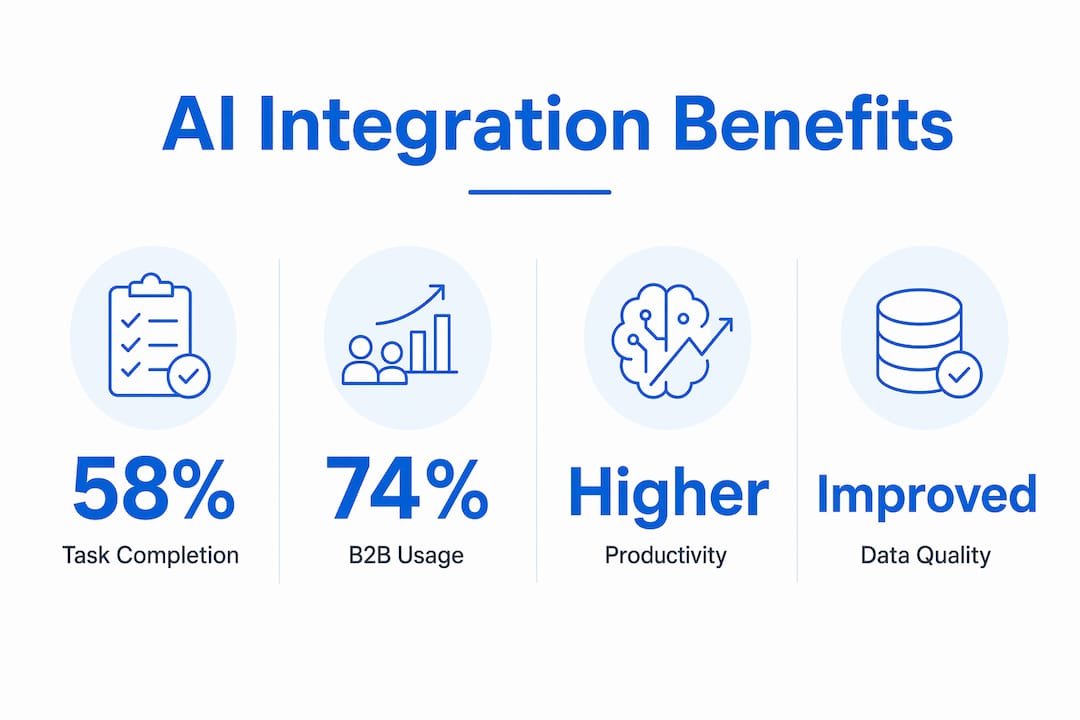
The business case for AI in customer support rests on four measurable outcomes: faster resolution, higher agent productivity, better data quality, and lower operational cost.
-
Faster customer resolution. AI handles routine enquiries instantly, around the clock. Customers no longer wait in queues for simple requests. This directly improves satisfaction scores and reduces abandonment rates.
-
Higher agent productivity. When AI absorbs repetitive interactions, agents focus on complex, high-value cases. Real-time AI assistance also reduces the time agents spend searching for information mid-call, cutting average handle time.
-
Improved data quality and insight. AI-assisted automation reduces manual data entry, which is a primary source of CRM errors. Cleaner data produces more reliable analytics and better forecasting.
-
Cost reduction through smarter resource allocation. Automating routine interactions reduces headcount pressure without reducing service quality. AI also enables after-hours coverage without shift premiums.
The Gartner finding that 58% of general AI users use AI to complete tasks, rising to 74% in B2B contexts, signals a clear expectation shift. Customers already use AI to get things done. Contact centres that cannot match that capability lose ground to third-party tools customers turn to instead.
The most durable benefit is the feedback loop. Integrated AI captures every interaction as structured data. That data trains the AI to perform better, which improves customer experience, which generates more useful data. Enterprises that start this loop early build a compounding advantage over those that delay.
How is AI technically integrated into existing contact centre systems?
The architecture of AI integration determines whether the system performs as promised or creates new problems. There are two broad approaches: native embedding and bolt-on layering.

Native embedding vs bolt-on layering
Native embedding means AI is built into the contact centre platform from the ground up, sharing the same data layer as the CRM, telephony, and communication channels. Bolt-on layering means a third-party AI tool is connected via API to an existing system. Both approaches work, but they carry different risk profiles.
Treating AI as a bolt-on feature rather than core infrastructure leads to data fragmentation and inconsistent customer experiences. When AI and CRM operate on separate data stores, the AI lacks the context to act intelligently. A customer who updated their address yesterday should not have to repeat it today. That kind of failure erodes trust quickly.
Integration methods and tools
APIs and iPaaS platforms are the standard connectors between AI modules and enterprise systems such as CRM, ERP, and communication platforms. iPaaS (Integration Platform as a Service) tools manage data flows between systems without requiring custom code for every connection. They are particularly useful when integrating AI with legacy telephony infrastructure that was not designed for modern data exchange.
The non-negotiable requirement is a unified data layer that supports real-time, bidirectional data flow. This means the AI can read from and write to the CRM simultaneously. When an AI voice agent confirms an appointment, the CRM record updates instantly. When a customer’s sentiment score crosses a threshold, the routing engine responds in real time.
Pro Tip: Before selecting an AI platform, map every system the contact centre currently uses, including telephony, CRM, ticketing, and billing. Any AI integration that cannot connect to all of them will create the data silos you are trying to eliminate.
Common integration challenges
Enterprises frequently underestimate integration complexity. Legacy system compatibility, inconsistent data formats, and the need to train AI on company-specific context are the three most common obstacles. Working with an experienced technical partner from the outset reduces the risk of operational disruption during deployment. The role of AI in communication orchestration across channels adds another layer of complexity that requires deliberate architectural planning.
What are practical use cases of AI integration in contact centres?
Real-world AI integration solves specific operational problems. The following use cases show how enterprises apply integrated AI across common contact centre workflows.
- Automated lead qualification: AI voice agents call inbound leads within seconds of enquiry submission, qualify them against predefined criteria, and book appointments directly into the sales calendar. No agent involvement is required until the meeting itself.
- Outbound SMS nurture sequences: Automated SMS workflows send contextual follow-up messages based on CRM triggers, such as a quote viewed but not accepted. The AI adjusts message timing and content based on prior responses.
- Sentiment-based call routing: AI analyses the tone and language of an inbound call in real time. Frustrated callers or high-value accounts are routed to senior agents immediately, before the situation escalates.
- Analytics-triggered CRM updates: When an AI agent completes a call, it writes a structured summary, outcome, and next action directly to the CRM record. This eliminates post-call wrap-up time and keeps data current.
- After-hours coverage: AI handles customer enquiries outside business hours, resolving what it can and queuing complex cases for the next available agent with full context attached.
- Hybrid escalation paths: AI manages the first layer of every interaction and hands off to a human agent when complexity exceeds its parameters. The agent receives the full conversation history, so the customer never repeats themselves.
Integrated AI agents that qualify leads, schedule appointments, and route urgent issues represent the practical standard for enterprise contact centres in 2026. The value is not in any single use case but in the compounding effect of automating multiple workflows simultaneously.
Key takeaways
Contact centre AI integration delivers measurable value only when AI is embedded as core infrastructure, not added as an afterthought to existing systems.
| Point | Details |
|---|---|
| Define integration correctly | Contact centre AI integration embeds NLP, machine learning, and conversational AI into existing systems for task completion, not just Q&A. |
| Prioritise task completion | Customers expect AI to complete transactions; 74% of B2B users use AI to get things done, not just find answers. |
| Build a unified data layer | Real-time bidirectional CRM integration is the technical foundation that makes context-aware AI possible. |
| Plan for integration complexity | Legacy compatibility, data silos, and AI training requirements are the three most common deployment obstacles. |
| Start the feedback loop early | Every AI interaction generates data that improves future performance; enterprises that deploy sooner compound their advantage faster. |
Why most contact centre AI projects fall short before they start
The honest truth about contact centre AI integration is that most projects fail at the planning stage, not the technology stage. I have seen enterprises spend months evaluating AI platforms while their underlying data architecture remains fragmented. The AI they eventually deploy is only as good as the data it can access, and if that data lives in three separate systems that do not talk to each other, no amount of sophisticated modelling will produce a coherent customer experience.
The other mistake I see repeatedly is designing AI around what the business finds convenient to automate rather than what customers actually need. Gartner’s research is unambiguous on this point: customers reach for third-party AI tools because those tools complete tasks. If your integrated AI can only answer FAQs, you have built something customers will bypass. The role of AI in customer service is shifting toward transactional capability, and enterprises that design for information retrieval alone are already behind.
My practical advice is to start with one high-volume, well-defined workflow, such as appointment booking or payment confirmation, and integrate it fully before expanding. A single workflow done properly, with real CRM connectivity and genuine task completion, teaches you more about your integration architecture than a broad pilot that touches everything superficially. Iteration after deployment is not optional. It is the mechanism by which integrated AI actually improves.
— Sowrabh
How Conversational AI supports enterprise contact centre integration
Australian enterprises face specific requirements around data sovereignty, privacy compliance, and multi-channel coverage that generic platforms do not address well.
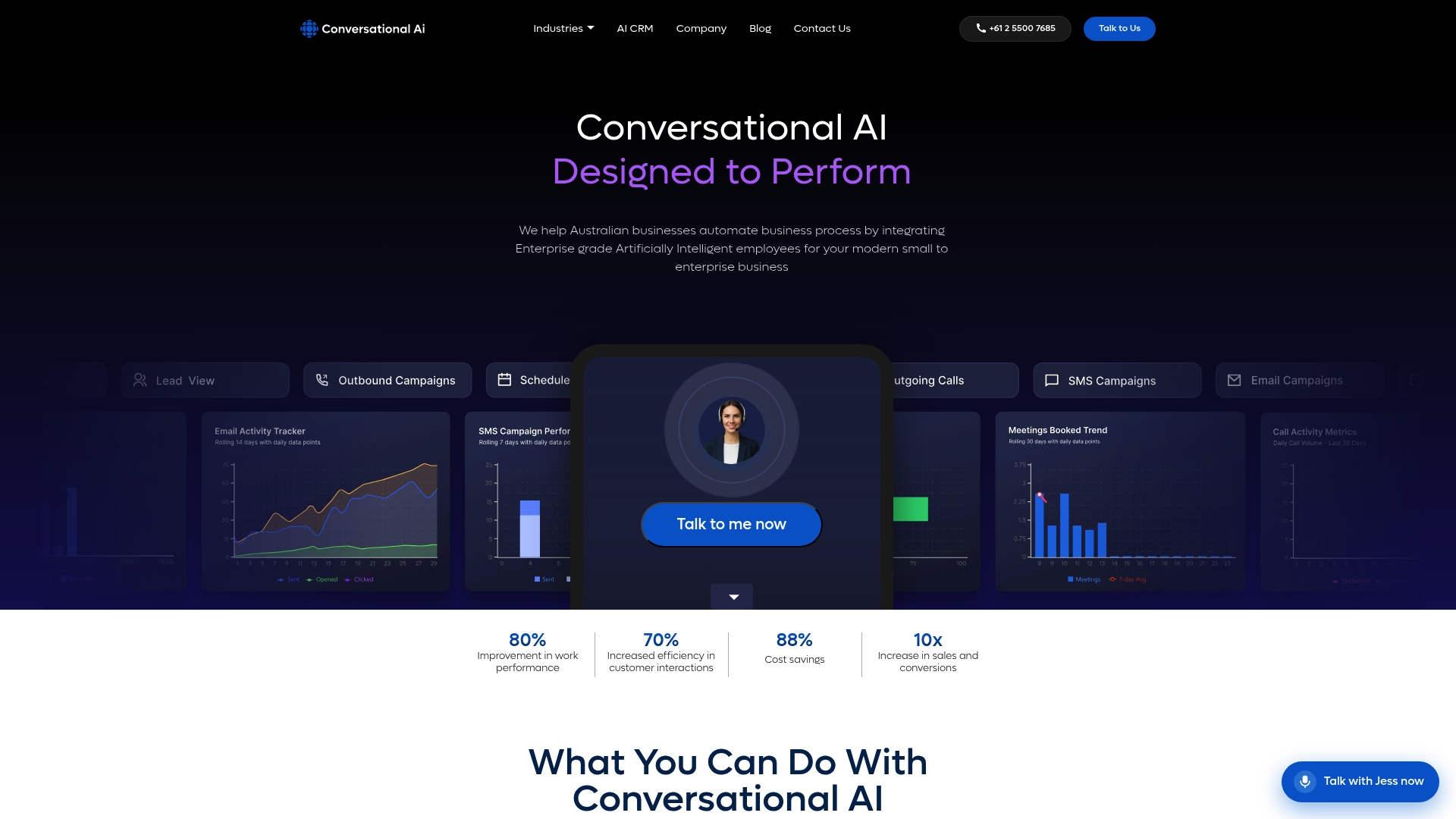
Conversational AI is built for this environment. The platform provides AI voice agents, SMS automation, email handling, and live chat within a single architecture hosted entirely in Australia. Every channel connects to your existing CRM through native integration, giving AI agents the real-time context they need to complete transactions, not just answer questions. The AI agents platform supports industries with high privacy requirements, including healthcare, finance, and professional services. If you want to see how integrated AI performs against your specific workflows, a live demo is the fastest way to assess fit.
FAQ
What is contact centre AI integration?
Contact centre AI integration is the embedding of AI technologies, including NLP, machine learning, and conversational AI, into contact centre systems to automate customer interactions and operational workflows. It enables AI to complete transactions, route calls, and update CRM records in real time.
How does AI integration differ from a standard chatbot?
A standard chatbot matches keywords to scripted replies. Integrated AI connects to live CRM data, understands context across a conversation, and completes tasks such as booking appointments or processing updates without human intervention.
What are the main benefits of AI integration in contact centres?
The primary benefits are faster customer resolution, higher agent productivity, improved data quality, and lower operational costs. AI also enables 24/7 coverage without additional staffing costs.
What technical challenges should enterprises expect?
Legacy system compatibility, inconsistent data formats, and the need to train AI on company-specific context are the most common obstacles. Enterprises that underestimate these challenges risk operational disruption during deployment.
How long does contact centre AI integration typically take?
Deployment timelines vary based on system complexity and the number of channels involved. A single well-defined workflow can be integrated in weeks; full multi-channel deployment across legacy infrastructure typically takes several months.