AI automation for Australian businesses explained
Discover how AI automation transforms Australian businesses. This guide explains key benefits, costs, and compliance for effective implementation.

AI automation is software that uses artificial intelligence to handle repetitive business tasks without human intervention, freeing your team to focus on work that actually requires judgement. For Australian business leaders, understanding AI automation means understanding a genuine shift in how organisations operate, not just a technology upgrade. The industry term is “intelligent process automation,” and it covers everything from enquiry follow-up and invoice processing to review requests and appointment booking. Australian Privacy Principles under the Privacy Act 1988 and the Spam Act 2003 govern how this automation handles personal data, making compliance a design requirement, not an afterthought. This guide covers the benefits, costs, implementation steps, and compliance obligations you need to make informed decisions.
What are the main benefits and costs of AI automation in Australia?
The productivity case for AI automation in Australian businesses is well established. 81% of Australian mid-sized business leaders report a positive productivity impact from AI in 2026. When AI is embedded into core processes rather than used as a standalone tool, that figure rises to 93%. Macquarie Bank demonstrated this at scale, saving 130,000 work hours in just seven months of AI deployment. Nearly 80% of Macquarie staff were using AI daily within that same period, which shows how quickly adoption can spread when the rollout is well managed.

What does AI automation actually cost for Australian SMEs?
Cost is the first question most business leaders ask, and the answer is more accessible than most expect. AI automation stacks for Australian SMEs typically cost $200 to $800 AUD per month in software subscriptions, with setup fees generally under $5,000 AUD. Most businesses recover that setup cost within two to three months through time saved and increased throughput. That payback period is short enough to justify a pilot project without a lengthy board approval process.
The direct benefits include faster lead response times, reduced manual data entry, and improved cash flow from automated invoicing and follow-ups. Indirect benefits include fewer errors, better customer experience, and staff who spend less time on low-value tasks. For sectors like healthcare, finance, and professional services, the compliance benefits of consistent, auditable automated communication add another layer of value.
Pro Tip: Calculate your current cost of handling one repetitive workflow manually, including staff time, error correction, and delays. Compare that to a $400 AUD monthly subscription. The business case usually writes itself.
How do Australian businesses implement AI automation successfully?
The biggest mistake Australian businesses make is trying to automate everything at once. Only 10% of Australian firms invest in AI strategically, while 70% have adopted AI in some form. That gap between adoption and strategic investment explains why so many organisations see limited returns. A focused, measurable approach produces far better outcomes than a broad rollout.
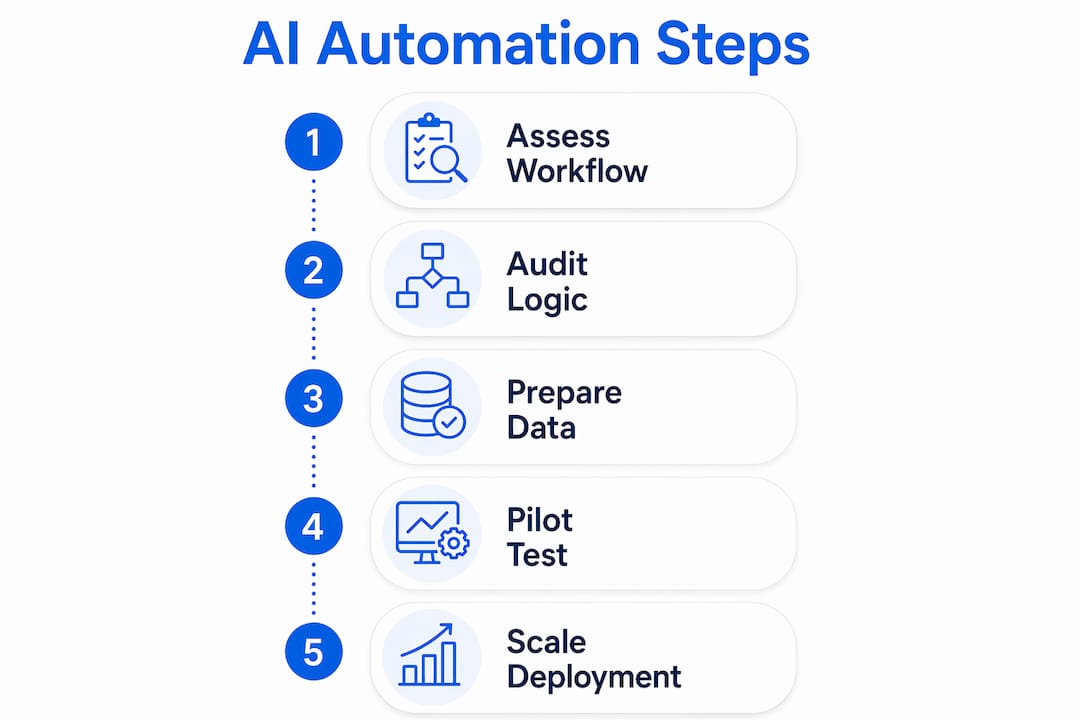
A practical implementation follows this sequence:
-
Identify one high-frequency, repetitive workflow. Choose a process your team handles dozens of times each week, such as lead qualification, appointment reminders, or invoice follow-up. High frequency means faster feedback on whether the automation is working.
-
Audit the workflow before automating it. Automating a broken process produces broken results faster. Map every step, identify the handoffs, and fix the logic gaps before any AI touches it.
-
Prepare your data. Clean, accessible internal data such as CRM records and customer communication history is what makes AI automation accurate. Without structured data, automation tools produce generic, context-free outputs that frustrate customers.
-
Run a 90-day pilot. Limit the pilot to one workflow and one team. Set measurable targets upfront, such as response time, error rate, or hours saved. Review results at 30, 60, and 90 days.
-
Involve risk and compliance partners early. Successful pilots include compliance teams from the design stage. This embeds privacy by design, speeds up approvals, and reduces the risk of costly rework later.
-
Train your team on the new workflow. Governance and workforce training are the most underestimated factors in AI adoption. Staff who understand why the automation exists and how to override it when needed are far more likely to trust and use it effectively.
-
Scale based on evidence. Once the pilot delivers measurable results, apply the same methodology to the next workflow. Each successful pilot builds organisational confidence and reduces resistance to further adoption.
Pro Tip: Explore automated SMS workflows as a starting point. SMS has high open rates and works well for appointment reminders and follow-ups, making it an ideal first automation project.
What compliance obligations apply to AI automation in Australia?
Australian law places clear obligations on businesses that use AI automation to communicate with customers or handle personal data. Getting this wrong is not just a reputational risk. It carries real legal consequences.
The key compliance requirements are:
-
Australian Privacy Principles (APPs) under the Privacy Act 1988. These govern how you collect, store, use, and disclose personal information. Any automated workflow that processes customer data must comply with the APPs. Businesses with annual turnover above $3 million AUD have stricter obligations, though many smaller businesses are also covered depending on the type of data they handle.
-
Spam Act 2003. Automated email and SMS communications must include clear sender identification, a functional opt-out mechanism, and explicit consent from the recipient. Consent, identification, and opt-out options are not optional features. They are legal requirements.
-
Data sovereignty. Storing customer data on overseas servers can create compliance complications under Australian law. Platforms that host data within Australia give you direct control and reduce cross-border data risk.
-
Human accountability. AI-driven decisions that affect customers, such as credit assessments or medical triage, require a human accountable for the outcome. Automation does not transfer legal responsibility away from your organisation.
-
Privacy by design. Embed compliance requirements into the automation workflow from the start. Retrofitting compliance after deployment is expensive and often incomplete.
The Office of the Australian Information Commissioner (OAIC) provides guidance on applying the APPs to automated systems. Reviewing that guidance before your pilot begins is time well spent.
How is AI automation changing workflows and jobs in Australian organisations?
The most important insight from recent research is that AI automation delivers the greatest value when you redesign workflows around AI capabilities, not when you simply attach AI to existing processes. This distinction separates organisations that see genuine productivity gains from those that see marginal improvements.
“AI doesn’t need to outperform humans at every task to create value. The key is sequencing tasks so that AI can handle an end-to-end workflow without constant human handoffs. Grouping AI-compatible tasks together reduces coordination costs and produces compounding efficiency gains.”
MIT Sloan Management Review, How AI is reshaping workflows and redefining jobs
This principle has direct implications for how you structure your teams. A customer service workflow that currently involves a human reading an email, logging it in a CRM, drafting a response, and scheduling a follow-up call can be redesigned so AI handles the first three steps automatically. The human then receives a prioritised queue of calls that genuinely require their judgement. The role does not disappear. It shifts to higher-value work.
AI in customer service is one of the clearest examples of this shift in Australian organisations. Businesses that redesign their customer service workflows around AI capabilities report faster resolution times and higher customer satisfaction, not because AI replaces empathy, but because it removes the administrative friction that slows human agents down.
The broader organisational implication is significant. AI automation is an organisational design challenge as much as a technology implementation. Leaders who treat it purely as an IT project miss the workflow redesign opportunity that produces the largest returns.
Key takeaways
AI automation delivers the greatest returns for Australian businesses when compliance is embedded from the start, workflows are redesigned rather than simply automated, and pilots are measured before scaling.
| Point | Details |
|---|---|
| Start with one workflow | Pilot a single high-frequency process for 90 days before expanding to other areas. |
| Costs are accessible | Most Australian SME setups cost $200–$800 AUD monthly and recover setup costs within three months. |
| Compliance is non-negotiable | The Privacy Act 1988 and Spam Act 2003 require consent, opt-outs, and data controls built into every automated workflow. |
| Redesign before automating | Fixing workflow logic before adding AI produces far better results than automating a broken process. |
| Strategic investment matters | Embedding AI into core processes lifts productivity impact from 81% to 93% among Australian mid-sized businesses. |
My honest assessment of AI automation adoption in Australia
I have watched a lot of Australian businesses approach AI automation the same way they approached cloud adoption a decade ago: with enthusiasm, a vendor shortlist, and no clear plan for what they actually want to automate. The result is predictable. They spend money, see modest results, and conclude that AI is overhyped.
The businesses that get genuine value share one habit. They start with a problem, not a product. They pick one workflow that is genuinely painful, measure its current performance, and then ask whether AI can improve it. That discipline sounds obvious, but it is rare. Most leaders are drawn to the broad vision and skip the unglamorous work of workflow mapping and data preparation.
The compliance piece is where I see the most avoidable risk. Businesses in healthcare and finance often assume their existing privacy frameworks cover AI automation. They frequently do not. Automated communications have specific obligations under the Spam Act 2003 that differ from manual communications, and the OAIC’s guidance on automated decision-making is worth reading before you go live, not after a complaint lands.
My practical advice: treat your first AI automation project as a learning exercise, not a cost-cutting exercise. The real payoff comes in the second and third projects, when your team understands the methodology and your data is clean enough to support more complex workflows. Sustainable scaling after initial wins requires that foundation.
— Sowrabh
How Conversational AI supports Australian business automation
Australian businesses looking to move from theory to practice need a platform built for local compliance requirements, not adapted from an overseas product.
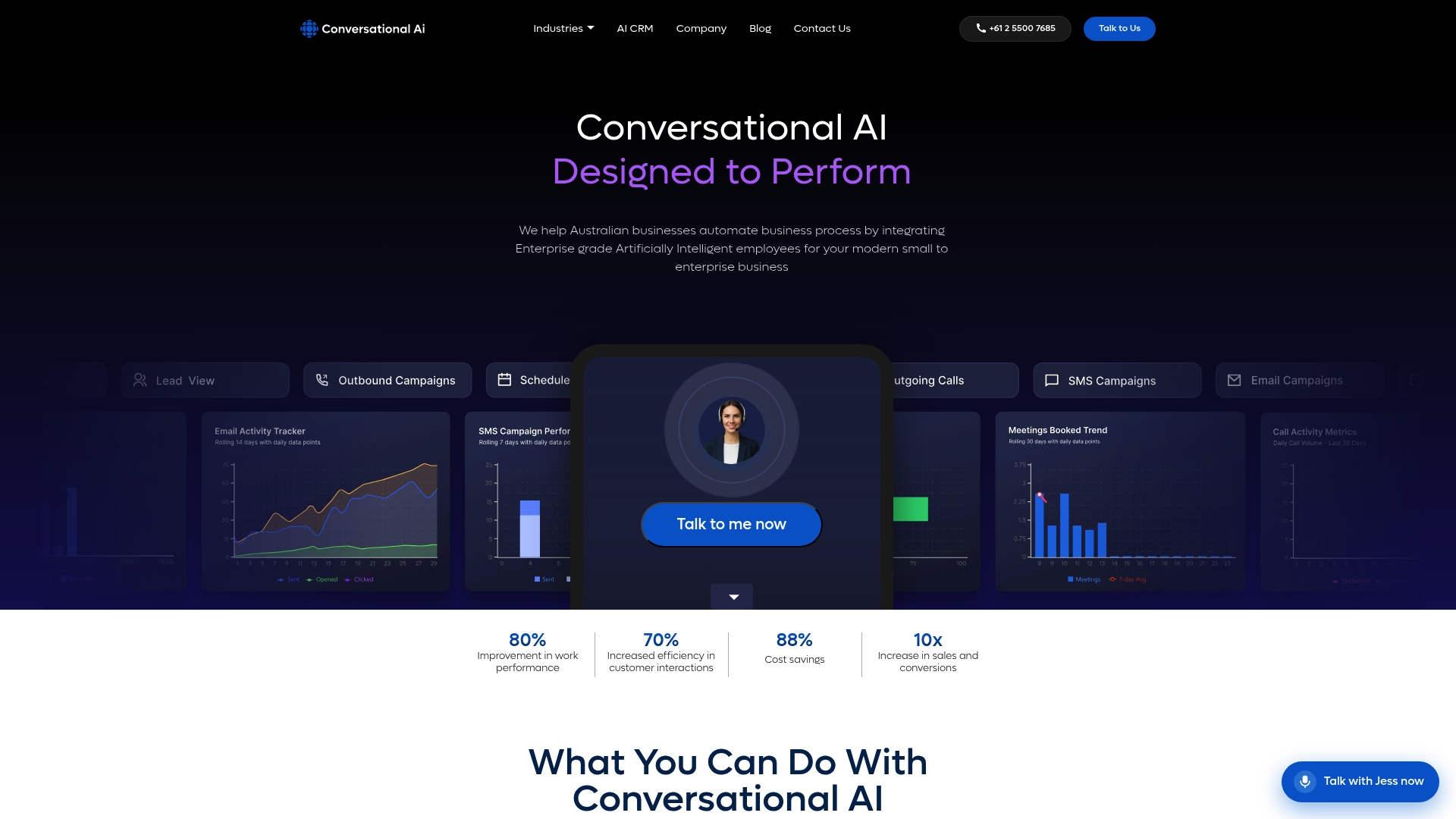
Conversational AI is built specifically for Australian businesses, with data hosted entirely within Australia to support Privacy Act 1988 compliance and data sovereignty requirements. Its AI agents handle voice, SMS, email, and live chat across industries including healthcare, finance, and professional services. Features include natural language understanding, contextual memory, automated follow-ups, and real-time analytics, giving your team full visibility over every automated interaction. For businesses ready to move beyond manual processes, Conversational AI’s AI agents offer a practical starting point with the compliance controls Australian enterprises require.
FAQ
What is AI automation for Australian businesses?
AI automation is software that uses artificial intelligence to handle repetitive business tasks, such as customer enquiries, appointment bookings, and invoice follow-ups, without human intervention. It operates within Australian regulatory frameworks including the Privacy Act 1988 and Spam Act 2003.
How much does AI automation cost for an Australian SME?
Most Australian SME automation setups cost between $200 and $800 AUD per month in software subscriptions, with initial setup fees typically under $5,000 AUD. Businesses generally recover setup costs within two to three months through time savings and increased throughput.
What compliance rules apply to AI automation in Australia?
The Australian Privacy Principles under the Privacy Act 1988 and the Spam Act 2003 both apply. Automated communications must include sender identification, consent, and opt-out options, and personal data must be handled in line with APP obligations.
How do I start implementing AI automation in my business?
Start with one high-frequency, repetitive workflow, audit and fix its logic, prepare your data, and run a 90-day pilot with measurable targets. Involve compliance and risk teams from the design stage to avoid costly rework.
Does AI automation replace jobs in Australian organisations?
AI automation shifts work rather than eliminating it. Repetitive, administrative tasks move to AI, while human roles shift toward judgement-based work that requires context, empathy, and accountability. Workflow redesign is the key to making this transition productive.