Role of voice AI in outreach: 2026 guide
Explore the role of voice AI in outreach for 2026. Discover how AI-powered voice agents boost lead qualification and improve sales results.

Voice AI in outreach is defined as the deployment of AI-powered voice agents that conduct real-time, automated phone conversations to qualify leads, book meetings, and re-engage prospects at scale. The role of voice AI in outreach has shifted from experimental to operational: 41% of enterprise B2B teams now use at least one AI SDR or voice agent, up from 12% in 2025. That adoption rate reflects a genuine shift in how outreach teams think about first-touch communication. For marketing professionals and outreach strategists, understanding what voice AI can and cannot do is the difference between a well-run programme and wasted budget.
How does voice AI boost outreach effectiveness and sales results?
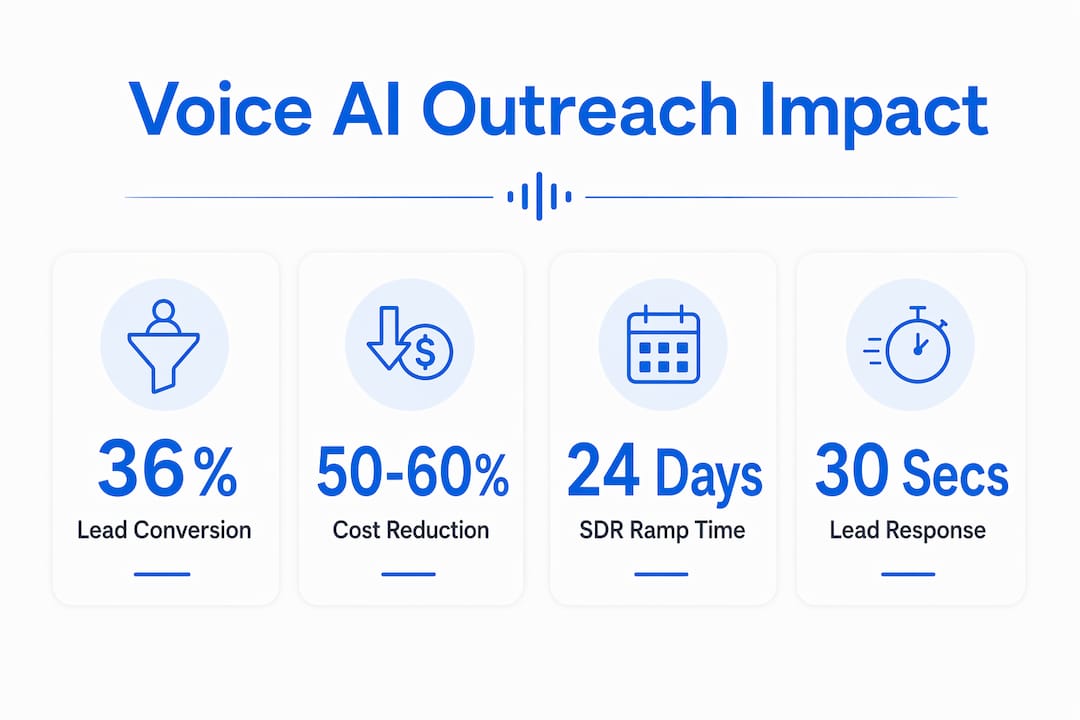
Voice AI agents deliver measurable performance gains across the core metrics that outreach teams track. Deploying AI voice agents for lead qualification boosts conversion rates by 36%, reduces cost-per-meeting by 50–60%, and cuts ramp time from 4.7 months to 24 days. Those numbers matter because they represent real budget and headcount implications for medium to large organisations.
The mechanism behind these gains is speed and consistency. When a voice AI agent calls a new lead within 30 seconds of form submission, demo-to-show rates increase by 3–5 times compared to delayed human follow-up. Speed-to-lead is a well-documented driver of conversion, and AI removes the human delay entirely. AI meeting confirmation calls also reduce no-shows by 30–45%, which compounds the conversion gain further.

The cost reduction is equally significant. A human SDR team carries salary, benefits, management overhead, and a months-long ramp period. Voice AI agents reach full productivity in days, not quarters. That efficiency gain frees your human reps to focus on the conversations that actually require judgement and relationship depth.
Key performance improvements voice AI delivers in outreach:
- 36% uplift in lead qualification conversion rates with intent-driven voice AI
- 50–60% reduction in cost-per-meeting compared to human-only outreach
- 3–5x increase in demo-to-show rates when calling within 30 seconds of lead submission
- 30–45% fewer no-shows with AI-powered meeting confirmation calls
- Ramp time reduced from 4.7 months to 24 days for new outreach capacity
Pro Tip: Track cost-per-meeting alongside conversion rate from the start. Cost-per-meeting is the clearest signal of whether your voice AI deployment is generating real pipeline efficiency or just volume.
What are the practical deployment models for voice AI outreach?
The most effective deployment model is not full automation. Hybrid pod workflows combining AI voice agents with human reps reduce cost per opportunity by 54% and outperform pure AI implementations on close rates for high-value deals. The model works because it assigns each task to the resource best suited for it.
A practical hybrid pod operates in four stages:
- First-touch qualification. The AI voice agent calls every new inbound lead within seconds, runs a structured qualification script, and scores the prospect based on job title, industry, and stated intent.
- Lead re-engagement. Dormant leads from your CRM receive automated voice outreach on a scheduled cadence. The AI handles objection handling scripts and books meetings directly into your calendar system.
- Meeting confirmation. The AI calls booked prospects 24 hours before the meeting, confirms attendance, and reschedules no-shows automatically.
- Human handoff. Qualified, confirmed prospects are passed to a human rep for discovery, negotiation, and closing. The rep receives a full call summary and qualification notes from the AI interaction.
This structure means your human reps spend their time on conversations that require empathy, creative problem-solving, and relationship management. The AI handles the volume work that would otherwise burn out your SDR team.
CRM integration is non-negotiable in this model. Treating voice AI as an infrastructure layer integrated into your CRM and multichannel communication stack enables real-time data feedback, dynamic personalisation, and efficient handoffs. Without CRM integration, you lose the data continuity that makes the hybrid model work. Voice AI also pairs naturally with SMS, email, and LinkedIn follow-ups, creating a coordinated outreach sequence rather than isolated calls.
Pro Tip: Build your AI voice agent scripts around the same qualification framework your best human reps use. The AI should mirror your top performer’s opening questions, not a generic template.
What challenges should marketers consider with voice AI outreach?
The most immediate challenge is buyer fatigue. AI-driven noise is a real and growing problem in outbound sales. The same AI adoption that drives efficiency for senders is creating a wall of automated calls for buyers. The blended reply rate across AI-assisted outbound has already dropped from 4.7% to 2.9% as volume has increased. More calls does not mean more conversations.
Technical quality is the second challenge. Voice AI agents require sub-500ms latency and advanced voice activity detection to maintain conversational naturalness. Latency above 500ms and poor voice activity detection create robotic pauses that immediately signal to a prospect that they are talking to an AI. That signal ends most conversations before qualification begins.
“The primary risk in AI outreach is buyer fatigue from robotic interactions. Best practice is to reserve humans for insight-led conversations and let AI handle high-volume repetitive work.”
Three further risks outreach strategists need to manage:
- Over-automation on high-value deals. Pure AI implementations underperform by 22 points in close rates on complex, high-value deals. AI should not be the closing mechanism.
- AI-to-AI communication. By end of 2027, 19–26% of inbound replies are predicted to be handled by AI agents on the buyer side. Your outreach strategy needs to account for AI gatekeepers, not just human ones.
- Compliance and consent. Automated voice calls in Australia are subject to the Spam Act 2003 and ACMA regulations. Any voice AI deployment must include proper consent frameworks and opt-out mechanisms.
The answer to most of these challenges is the same: use intent data to target the right prospects, keep humans in the loop for complex scenarios, and monitor quality metrics continuously rather than setting the system and walking away.
How can marketing professionals integrate voice AI strategically?
Voice AI works best when you treat it as a communication infrastructure layer, not a standalone tool. Systematic CRM integration enables real-time trigger-based follow-ups across multiple channels, which transforms voice AI from a dialler into a pipeline management system. The difference in outcomes between these two approaches is substantial.
Personalisation is the variable that separates high-performing voice AI deployments from average ones. AI voicebots using enriched data such as job title, industry, and intent signals achieve answer rates exceeding 40%. Generic scripts with no personalisation perform far below that benchmark. Your CRM data is the fuel; the voice AI agent is the engine.
The table below outlines the key metrics to track across your voice AI outreach programme:
| Metric | What it measures | Why it matters |
|---|---|---|
| Answer rate | Percentage of calls connected | Baseline reach efficiency |
| Qualification rate | Leads meeting criteria per call | Quality of targeting and script |
| Cost-per-meeting | Total spend divided by meetings booked | Core ROI indicator |
| No-show rate | Confirmed meetings not attended | Measures confirmation effectiveness |
| Handoff-to-close rate | Qualified leads that convert to revenue | End-to-end pipeline health |
Multichannel orchestration amplifies every metric in this table. A voice call followed by an SMS summary and a LinkedIn connection request performs better than a voice call alone. You can read more about coordinating these channels in this guide to voice, SMS and email automation. The key principle is that voice AI initiates and qualifies; other channels reinforce and nurture.
Pro Tip: Run A/B tests on your AI opening scripts every four weeks. Small changes to the first 10 seconds of a call, such as leading with a specific pain point rather than a company introduction, can shift answer and qualification rates significantly.
Key takeaways
Voice AI in outreach delivers its strongest results when deployed as an integrated infrastructure layer within a hybrid human-AI workflow, not as a standalone dialler.
| Point | Details |
|---|---|
| Conversion and cost gains are real | Voice AI lifts lead qualification rates by 36% and cuts cost-per-meeting by 50–60%. |
| Hybrid models outperform pure automation | Combining AI qualification with human closing reduces cost per opportunity by 54%. |
| Technical quality determines outcomes | Sub-500ms latency and voice activity detection are required for natural conversations. |
| Personalisation drives answer rates | Enriched CRM data such as job title and intent signals pushes answer rates above 40%. |
| Buyer fatigue is a growing risk | Reply rates have already dropped as AI outreach volume increases; targeting quality matters more than volume. |
Voice AI in outreach: where I think this is actually heading
I have watched a lot of outreach technology cycles come and go, and the pattern is usually the same. A new capability arrives, teams rush to maximise volume, reply rates drop, and then the smarter operators pull back and focus on quality. Voice AI is following exactly that arc right now.
The teams winning with voice AI in 2026 are not the ones running the most calls. They are the ones who have done the harder work: integrating voice AI with their CRM, building personalised scripts from real intent data, and keeping their best human reps focused on the conversations that actually require a human. That combination is genuinely difficult to replicate at scale without the right infrastructure.
What concerns me is the assumption that AI can replace human judgement in complex sales scenarios. The data is clear that pure AI underperforms on high-value deals. The organisations that will get the most from voice AI are the ones that understand its role in the orchestration of communication rather than treating it as a replacement for their sales team.
My advice: start with one use case, measure everything, and build from there. Lead re-engagement is usually the best entry point because the stakes are lower and the volume justifies automation immediately. Get that working well before you expand to first-touch qualification.
— Sowrabh
How Conversational AI supports Australian outreach teams
Australian businesses face specific requirements around data sovereignty and privacy compliance that generic offshore platforms do not address. Conversational AI is built for this environment.
Conversational AI delivers enterprise-grade AI voice agents for Australian businesses hosted entirely within Australia, ensuring full compliance with local data privacy regulations. The platform supports voice, SMS, email, and live chat within a single orchestration layer, with CRM integration and real-time analytics built in. Whether you are running lead qualification, meeting confirmation, or after-hours outreach, Conversational AI gives your team the infrastructure to do it at scale without compromising on data control. Contact the team to arrange a demonstration tailored to your outreach workflow.
FAQ
What is the role of voice AI in outreach?
Voice AI in outreach automates real-time phone conversations for lead qualification, meeting booking, and prospect re-engagement at scale. It handles high-volume, repetitive outreach tasks so human reps can focus on complex sales conversations.
How much can voice AI reduce outreach costs?
Voice AI reduces cost-per-meeting by 50–60% and cuts SDR ramp time from 4.7 months to 24 days. These savings come from removing manual dialling, reducing no-shows, and accelerating qualification at scale.
What is a hybrid pod model in voice AI outreach?
A hybrid pod model pairs AI voice agents with human sales reps, assigning qualification and confirmation tasks to AI and discovery or closing to humans. This approach reduces cost per opportunity by 54% compared to human-only teams.
What are the biggest risks of using voice AI for outreach?
Buyer fatigue from AI-generated calls, technical latency above 500ms, and over-automation on high-value deals are the three primary risks. Maintaining human involvement in complex negotiations and using intent data for targeting reduces all three.
Does voice AI work for after-hours outreach?
Voice AI agents operate continuously without staffing constraints, making them well suited for after-hours lead qualification and follow-up. This is particularly valuable for organisations with leads arriving across multiple time zones or outside business hours.