How to migrate legacy systems to conversational AI
Learn how to migrate legacy systems to conversational AI for improved efficiency and customer engagement. Avoid common pitfalls. Get started today!

Migrating legacy systems to conversational AI means updating, integrating, and modernising outdated architectures so they can support AI-powered communication channels like voice, SMS, email, and live chat. The industry term for this process is legacy system modernisation, and it is the foundational step before any broader digital transformation can succeed. Australian enterprises that get this right unlock measurable gains in operational efficiency and customer engagement. Those that rush it face costly failures, extended downtime, and systems that are harder to manage than the ones they replaced.
What do you need before you migrate legacy systems to conversational AI?
Preparation determines whether a migration succeeds or stalls. Before a single line of code changes, you need a complete inventory of your existing systems, including all integrations, data flows, and dependencies. Without this map, you are flying blind.
Three areas demand attention before migration begins:
- System inventory and assessment. Document every application, database, and API endpoint. Identify which components are stable and which create friction. Stable components are worth preserving; friction-heavy parts are your migration targets.
- Conversational AI platform requirements. Your chosen platform must support API-first integration. Conversational AI opens new engagement channels and delivers operational efficiencies, but only when the underlying architecture supports modern, API-driven connectivity.
- AI-assisted documentation tools. AI tools can analyse legacy codebases and generate human-readable documentation. This documentation becomes the blueprint for redesign, not a direct code replacement.
| Preparation area | Why it matters |
|---|---|
| System inventory | Prevents surprise dependencies surfacing mid-migration |
| API readiness assessment | Confirms integration points for conversational AI agents |
| AI-generated documentation | Provides a redesign blueprint from undocumented legacy code |
| Design Authority setup | Governs code quality and prevents technical debt accumulation |
Pro Tip: Establish a Design Authority before migration begins. This governance body reviews AI-generated code, sets quality gates, and ensures every output meets production standards before it goes live.
Legacy migration costs for critical regulated applications typically range from €400,000 to €1.2 million, with core system rebuilds extending to 24–48 months. That figure puts the cost of poor preparation into sharp relief.
How do you plan and execute a phased migration approach?
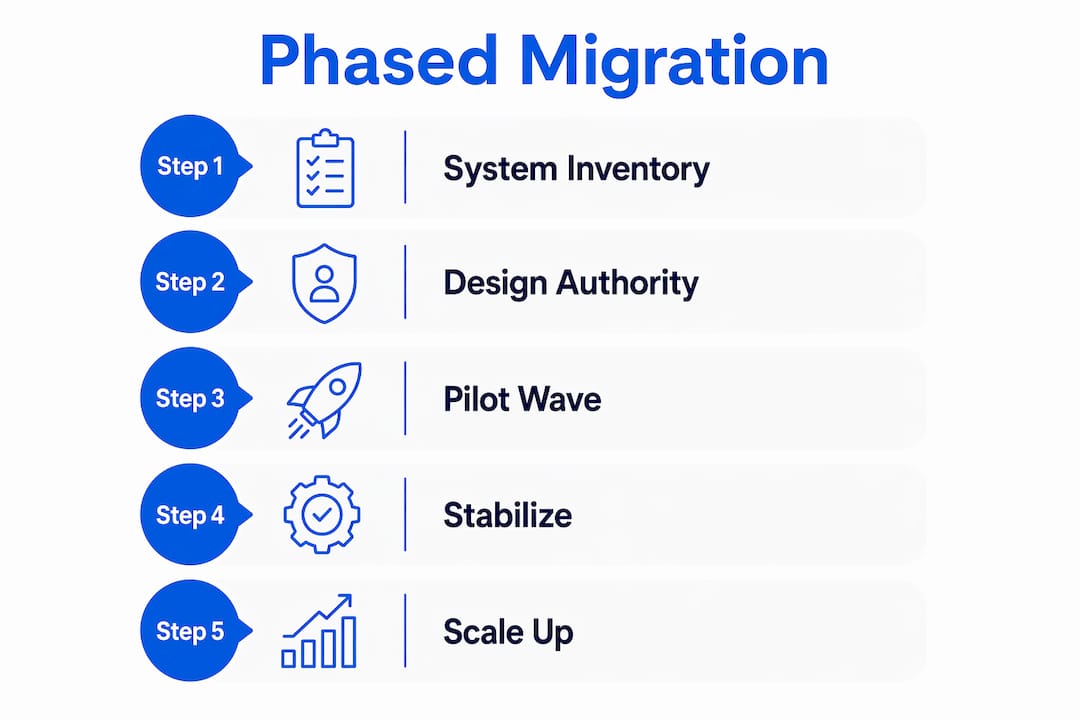
A phased migration is the most reliable path from legacy infrastructure to conversational AI deployment. Legacy modernisation is best treated as a business transformation, not a technical project. You protect stable components and replace friction-heavy parts sequentially, building confidence with each wave.
Follow these steps in order:
- Select a pilot project. Choose a bounded, lower-risk process with clear inputs and outputs. A single customer service workflow or an appointment booking process works well. Avoid starting with core financial or compliance systems.
- Run the full migration workflow on the pilot. Take it through assessment, code changes, data migration, testing, cutover, and a hyper-care period. Documenting lessons from this pilot reduces risk in every subsequent wave.
- Apply the strangler fig pattern. This technique incrementally replaces legacy functions with AI-enabled services. New conversational AI capabilities sit alongside the old system and gradually take over traffic. Business continuity stays intact throughout.
- Run parallel operations during cutover. Keep the legacy system live while the new conversational AI layer handles real traffic. Compare outputs. Only decommission the legacy component once the new system proves stable.
- Validate and test at every gate. Automated testing catches regressions early. Manual validation confirms that customer-facing behaviour matches expectations before each wave scales.
The speed gains from targeting the right pilot can be significant. AWS reports that migrating specific batch-oriented PL/I transactions to a cloud event-driven architecture can be completed in approximately 12 hours using automated AI-driven tools. That result depends entirely on selecting a well-scoped pilot and having clean documentation in place first.
Pro Tip: Do not scale to wave two until wave one is fully stable and documented. Rushing the second wave before lessons are captured is the most common cause of compounding failures in enterprise migrations.
What technical strategies convert legacy systems for conversational AI?
The technical execution of legacy system automation relies on four core approaches. Each addresses a different layer of the migration challenge.

AI-generated documentation as the redesign foundation
Direct AI code translation from one language to another often fails because legacy systems carry structural quirks and undocumented dependencies that AI cannot reliably interpret. The more reliable use of AI is generating intermediate, human-readable documentation from legacy code. Your architects then use that documentation to redesign the system properly, rather than inheriting the original system’s flaws in a new language.
API-first integration and service layers
Conversational AI platforms require modern API endpoints to function. If your legacy system has no APIs, you build a service layer that exposes its core functions without rewriting the entire system. This approach lets you add voice, SMS, and email automation capabilities to existing infrastructure while the deeper migration proceeds in parallel.
Event-driven cloud architecture
Migrating batch-processing legacy systems to event-driven cloud architecture unlocks real-time responsiveness. Conversational AI agents depend on real-time data. A legacy system that processes transactions overnight cannot support a live chat agent answering customer queries at 2am. Event-driven architecture solves this by triggering actions as events occur, not on a schedule.
Human oversight of AI-generated code
AI-generated code frequently lacks the maintainability required for production systems. Treat every AI output as a draft. A Design Authority with automated testing pipelines must review and approve code before it reaches production. This is not optional. Skipping this step creates technical debt that compounds with every subsequent release.
| Integration approach | Best suited for |
|---|---|
| API service layer | Legacy systems with no existing API endpoints |
| Event-driven architecture | Batch systems needing real-time conversational AI support |
| AI-generated documentation | Undocumented codebases requiring redesign |
| Strangler fig pattern | Large systems requiring incremental, low-risk replacement |
What are the common migration risks and how do you avoid them?
Legacy system transformation carries real risks. Knowing them in advance lets you build mitigation into the plan rather than scrambling to fix problems under pressure.
The most common risks include:
- Data loss during migration. Incomplete data mapping causes records to drop or corrupt during transfer. Validate data integrity at every stage with automated checksums and reconciliation reports.
- Unplanned downtime. Big-bang replacements, where the entire legacy system is switched off and replaced at once, are the leading cause of extended outages. The strangler fig pattern exists specifically to avoid this.
- Integration failures. Conversational AI agents that cannot reach backend data sources fail silently or return incorrect information to customers. Test every integration point under realistic load before cutover.
- AI code quality issues. Establishing a Design Authority and automated testing is the primary defence against unmaintainable AI-generated code reaching production.
- Scope creep. Migrations that expand mid-project to include additional systems lose focus and exceed budgets. Lock scope for each wave before it begins.
“Modernisation is foundational and prerequisite to digital transformation success. Without it, broader AI initiatives lack the architecture they need to function.”
Rollback plans are not a sign of pessimism. They are a sign of professionalism. Every wave should have a documented rollback procedure that can be executed within a defined time window. Post-migration, treat modernisation as a continuous process. Enterprise leaders must invest in modern data platforms and DevOps practices to fully leverage AI capabilities after the initial migration completes.
Key takeaways
Migrating legacy systems to conversational AI requires a phased, governance-led approach that combines AI-assisted documentation, incremental refactoring, and API-first integration to deliver business value without disrupting operations.
| Point | Details |
|---|---|
| Prepare before you migrate | Complete a full system inventory and API readiness assessment before any code changes begin. |
| Use phased migration | Apply the strangler fig pattern to replace legacy functions incrementally and maintain business continuity. |
| Treat AI code as a draft | Establish a Design Authority and automated testing to validate every AI-generated output before production. |
| Pilot before scaling | Run one complete migration wave end-to-end and document lessons before expanding to subsequent waves. |
| Plan for continuous modernisation | Post-migration investment in DevOps and modern data platforms is required to sustain conversational AI performance. |
The uncomfortable truth about legacy migration I’ve learned over time
Most IT leaders I speak with underestimate how much of a legacy migration is a people and governance problem, not a technology problem. The tools exist. The patterns are well established. What derails projects is the assumption that AI can do the heavy lifting without rigorous human oversight at every gate.
I have seen organisations invest heavily in AI-assisted migration tools, only to deploy code that no one can maintain six months later. The technology did exactly what it was asked to do. The governance framework was not there to catch the gaps. A Design Authority is not bureaucracy. It is the difference between a migration that delivers lasting value and one that creates a new generation of legacy problems.
The other thing worth saying plainly: legacy modernisation is not a one-off project. Australian enterprises that treat it as a finite initiative with a completion date consistently struggle post-launch. The organisations that succeed treat it as an ongoing capability. They build DevOps practices, maintain documentation, and keep modernising incrementally. Conversational AI is not a destination. It is an operating model.
For Australian IT decision-makers specifically, data sovereignty adds a layer of complexity that offshore-focused guides often miss. Every architecture decision needs to account for Australian Privacy Act obligations and where data actually lives. That is not a constraint to work around. It is a design requirement from day one.
— Sowrabh
Conversational AI for Australian enterprise migration
Australian enterprises ready to move beyond legacy infrastructure need a platform built for local compliance requirements and enterprise-grade reliability.
Conversational AI is designed specifically for Australian businesses, with all data hosted within Australia to meet local privacy obligations. Its AI agents operate across voice, SMS, email, and live chat channels, integrating directly with existing CRM systems and infrastructure. Whether you are automating customer service, lead qualification, or appointment booking, the platform supports phased deployment alongside legacy systems. Speak with the Conversational AI team to map your current infrastructure against a migration pathway that fits your timeline and risk tolerance.
FAQ
How long does a legacy system migration to conversational AI take?
Critical regulated applications typically require 12–24 months to migrate, with core system rebuilds extending to 24–48 months. Pilot projects with well-scoped boundaries can complete a full migration wave significantly faster.
What is the strangler fig pattern in legacy migration?
The strangler fig pattern incrementally replaces legacy system functions with new AI-enabled services, allowing both systems to run in parallel until the legacy component can be safely decommissioned. It is the preferred approach for reducing downtime risk in enterprise migrations.
Can AI directly convert legacy code to a new language?
Direct AI code translation often fails due to structural and dependency differences in legacy systems. AI is more reliably used to generate human-readable documentation that informs a human-led redesign.
What is a Design Authority and why does migration need one?
A Design Authority is a governance body that reviews AI-generated code, sets quality standards, and approves outputs before they reach production. Without one, AI-assisted migrations frequently produce code that works initially but becomes unmaintainable over time.
Does conversational AI require a fully modernised system before deployment?
No. An API service layer can expose legacy system functions to conversational AI agents without a full system rewrite. This lets you add automated communication channels while the deeper migration proceeds in phases.