Conversational AI for Australian Finance: A Practical Guide
How Australian finance teams can deploy conversational AI across voice, SMS, email and chat while meeting APRA, ASIC and OAIC expectations on data and oversight.

Conversational AI in Australian finance means AI agents that hold real conversations with customers by voice, SMS, email and chat, and hand over to a person when the matter needs one. For a medium or large Australian financial organisation, the deciding factors are where customer data is processed, how the agents are governed under APRA and ASIC expectations, and whether the platform connects to your CRM and channels. We built our platform around those three tests: it is hosted entirely in Australia, runs as a private cloud, and covers voice, SMS, email and live chat with CRM integration.
This guide is for IT and operations leaders who already know they want automation and need to decide what to automate, what the regulators expect and how to prove it works.
TL;DR
- Conversational AI now goes well beyond static FAQ chatbots: generative agents can run live conversations by voice and messaging, with escalation to staff.
- Australian banks already report measurable results, such as CommBank’s 84.6% end-to-end resolution of self-service messaging interactions in May 2026.
- Four regulators (ASIC, APRA, OAIC and AUSTRAC) already oversee AI in financial services, and APRA’s CPS 234 and CPS 230 reach AI models, data and vendor contracts.
- Data residency, human escalation, consent, log retention and attack defences should be settled before go-live, not after.
- Judge success on containment rate, resolution quality and customer research, not on call deflection alone.
Table of Contents
- What conversational AI means in Australian finance
- What Australian institutions have already automated
- Which finance conversations to automate first
- The regulatory picture in plain terms
- Data sovereignty and security: the assessment that decides the shortlist
- Governance and human oversight
- A rollout path that holds up to scrutiny
- Measuring whether it is working
- What to look for in a platform
- Where we fit
- Our perspective
- FAQ
- Sources
What conversational AI means in Australian finance
Finance has used AI for decades. Narrow AI, which makes decisions from predetermined rules and algorithms, has long supported operations, servicing and risk management, as a 2025 KWM and Sapere study of the industry describes. Generative AI is different: it produces new content in response to prompts.
That difference matters for customer conversations. Mills Oakley notes that most financial-services chatbots in Australia are static, FAQ-style tools that generate nothing. The next step is generative AI that sustains live conversations, and, paired with audio, powers virtual call centres that answer member queries and guide people through digital journeys.
In practice, a modern conversational AI platform for a finance business does five things:
- Understands what the customer is asking in natural language, on any channel.
- Remembers the context of earlier interactions, so customers do not repeat themselves.
- Acts: books appointments, sends follow-ups, qualifies leads, takes payment-arrangement conversations.
- Writes everything back to your CRM so staff see the full history.
- Escalates to a person with the context attached.
The fourth and fifth points are where many projects stall. An agent that cannot see your CRM, or cannot hand over cleanly, creates more work than it saves.
What Australian institutions have already automated
The local evidence is strong enough to plan around.
Customer messaging and voice. CommBank built a customer-service platform with Microsoft. According to Channel Life’s report, an orchestration layer routes each request to automated services using public content, to controlled paths for regulated matters, or to human specialists. In May 2026, 84.6% of self-service messaging interactions were resolved end to end in the messaging channel, and the platform handles more than two million conversations a month across voice and messaging.
Always-on banking support. Macquarie launched Q in January 2026. Macquarie’s announcement describes an AI agent in its mobile app and online banking offering 24/7 support for everyday questions, with handoff to a team member during business hours, plus two-factor authentication and encryption.
Internal and email workloads. NAB’s virtual assistant saved the bank $1.2 million in support team costs within seven months and had been used 57,000 times across 800 use cases by 35,000 employees. Earlier, NAB’s email listeners auto-classified roughly 75% of 34,000 emails, against an original premise of about 40%.
Industry-wide. In the KWM and Sapere research cited above, one respondent said its chatbot handled the volume of more than 100 full-time employees, and another said chatbots handle about 50% of basic customer interactions. The same research expects generative AI adoption to double within three years.

The pattern across these examples is consistent. The wins come from routine, high-volume conversations, and the design keeps regulated or sensitive matters on controlled paths or with people.
Which finance conversations to automate first
Start where volume is high, the answer is well defined and the cost of a wrong answer is contained.
| Use case | Channel | Why it suits automation |
|---|---|---|
| Appointment booking and reminders | Voice, SMS | Repetitive, easy to verify, ties directly to CRM calendars |
| Lead qualification for lending, advice or insurance enquiries | Chat, voice, email | Structured questions, clear handoff to a banker or adviser |
| Payment reminders and arrangement conversations | SMS, voice, email | Consistent tone, follow-ups happen on schedule |
| After-hours customer questions | Chat, voice | Coverage without overnight rosters |
| Email triage | Classification and routing at volume | |
| Internal IT and HR helpdesk | Chat | Lower regulatory exposure, good proving ground |
We cover these workflows across our platform: voice, SMS, email and live chat agents, an AI receptionist, an AI sales employee, and industry pages for banking and finance and debt collection. If SMS is your first channel, our guide to automated SMS business workflows shows the common patterns. For multichannel design, see voice, SMS and email automation practices.
Keep the line between service and advice in view. iTnews reported in August 2026 that CBA’s AI Companion is expected to face scrutiny over whether its responses cross into regulated financial advice. Agents that answer account, booking and process questions sit on safer ground than agents that recommend products. Design your scope and your escalation rules around that boundary.
The regulatory picture in plain terms
Australia has no single AI statute for finance. Existing obligations apply, and several regulators enforce them.
Who is watching. Norton Rose Fulbright’s primer states that ASIC (conduct and licensing), APRA (prudential safety), the OAIC (privacy) and AUSTRAC (financial crime) already oversee AI in financial services.
What ASIC found. In Report REP 798, published 29 October 2024, ASIC analysed 624 AI use cases across 23 licensees in banking, credit, insurance and financial advice, as at December 2023. It documented a governance gap: the way AI innovation is overseen had not kept pace with its adoption.
What APRA requires. According to the same Norton Rose Fulbright primer, CPS 234 (information security) covers AI models, training data and inferences, treating them as information assets. CPS 230 (operational risk) means AI vendor contracts must be updated at the next renewal and no later than 1 July 2026. If you are signing or renewing a conversational AI contract now, that clause belongs in your checklist.
What industry says. The Australian Finance Industry Association argued in June 2025 that existing laws already apply to AI deployment, and that any new rules should target specific gaps. For a buyer, the practical reading is the same either way: build to current obligations now.
If you want the finance-specific detail, our write-ups on meeting APRA and OAIC rules, a 90-day CPS 234 playbook for AI and CPS 234 for chatbots go through the controls step by step.

Data sovereignty and security: the assessment that decides the shortlist
The Actuaries Institute’s framework for customer-facing chatbots gives a usable checklist. Turn it into your vendor questionnaire:
- Jurisdiction. Restrict processing of customer data to approved jurisdictions. Ask where the model runs, where transcripts and recordings are stored, and where backups and logs live.
- Privacy impact assessment. Complete one before launch, not after.
- Consent and escalation. Tell customers they are talking to AI, obtain consent where required and always offer a route to a human.
- Retention. Set limits on how long conversation logs are kept.
- Attack defences. Look for prompt-injection protection (input sanitisation, output filtering, system prompt protection), rate limiting to prevent model extraction, monitoring for adversarial patterns and regular penetration testing that includes AI-specific attacks.
- Breach terms. The framework notes that the NAAI’s 2025 model clauses require vendors to comply with Privacy Act obligations and to notify eligible data breaches within 72 hours.
EY adds a point worth putting in front of risk and compliance teams. Generative AI produces probabilistic, variable outputs, unlike deterministic software, so you should decide which conversations need guaranteed wording and keep those on scripted, controlled paths. EY also flags Privacy Act 1988 and Notifiable Data Breaches obligations, and bias risks in credit scores and loan offers.
For safeguards such as disclosure, consent and escalation in customer-facing bots, the article on AI chatbot types for Australian ecommerce is a useful companion on the customer-facing side of the same design questions.
Why hosting location is a design choice, not a footnote
When your agents handle identity details, account context and recorded voice, the simplest way to satisfy a jurisdiction restriction is to keep the whole stack onshore. Our platform is hosted entirely within Australia as a private cloud, gives you full control over your data, and holds SOC 2 certification. Where your policy requires it, we also offer on-premises deployment.
Governance and human oversight
APRA’s expectations are not about banning AI agents. They are about owning them. The research points to a short list of working practices:
- Treat AI as a tool, not a replacement. Norton Rose Fulbright advises that human oversight stays mandatory and that escalation thresholds should trigger manual review when outputs look anomalous.
- Hand off with context. Forrester analysts advise Australian banks to embed customer feedback loops and keep a human in the loop, with handoffs that carry full context.
- Test before and during operation. ASIC’s 2016 draft guidance on digital financial advice said testing should happen before advice is provided and on an ongoing basis, examining outputs for legal compliance. The principle carries over to any customer-facing agent.
- Research with real customers. The Actuaries Institute calls customer research with diverse segments the most important fairness control and the one most often omitted. Numbers alone will not show where an agent fails particular groups.
- Keep a register. A named owner and a list of every agent, its scope and its access make audits and board reporting straightforward.
A CRM-integrated platform helps here because every conversation, escalation and follow-up sits in one record. Our Conversational AI CRM keeps that history alongside the agents, and our reporting and analytics give operations teams visibility of what the agents did.
A rollout path that holds up to scrutiny
- Pick one workflow and one channel. Appointment confirmations by SMS, or after-hours chat, are typical starting points. Write down what the agent may answer and what it must pass on.
- Complete the privacy and security assessment. Use the checklist above and have risk sign off on residency, retention and breach terms.
- Connect the CRM and calendars. Integration is where value appears: the agent should read context and write outcomes back.
- Train on your own content. Use approved scripts, product information and policies so answers match your wording.
- Run a controlled pilot. Review transcripts weekly, tune escalation rules and run customer research on the experience.
- Expand by channel. Once chat or SMS is stable, add voice and email so customers get one consistent conversation across channels.
- Report to the board. Share containment, escalation reasons, incidents and near-misses on a regular cycle.
Our guide on communication orchestration and on after-hours communication can help you sequence steps 1 and 6.
Measuring whether it is working
The Actuaries Institute recommends adoption tracking that measures actual customer take-up and the successful containment rate, plus customer research to confirm the system meets real needs. Containment means the conversation was resolved without a human taking over, so count it only when the customer’s issue was in fact resolved.
Australian figures give you reference points, each from its own period and scope:
- NAB’s virtual assistant: $1.2 million saved in support costs within seven months (2022 report).
- NAB’s email listeners: about 75% auto-classification (2019 report).
- NAB’s Amazon Connect programme: 80% IVR containment and 95% telephone self-service, per NAB’s own presentation.
- CommBank: 84.6% end-to-end messaging resolution in May 2026.
Treat these as the shape of what is possible, not a promise for your business. Your own baseline, taken before launch, is the benchmark that matters: handle time, abandonment, after-hours volume and cost per resolved contact. Then add the quality measures: escalation reasons, complaint rates, customer satisfaction and review findings.
What to look for in a platform
| Requirement | What good looks like |
|---|---|
| Data residency | Processing, storage, logs and backups in Australia |
| Channels | Voice, SMS, email and live chat on one platform |
| CRM integration | Two-way, so context goes in and outcomes come back |
| Security assurance | Independent certification such as SOC 2, plus clear breach-notification terms |
| Deployment options | Private cloud, with on-premises where policy demands it |
| Oversight | Escalation rules, transcripts, analytics and role-based access |
| Sector fit | Experience with finance, healthcare and other privacy-sensitive workflows |
Where we fit
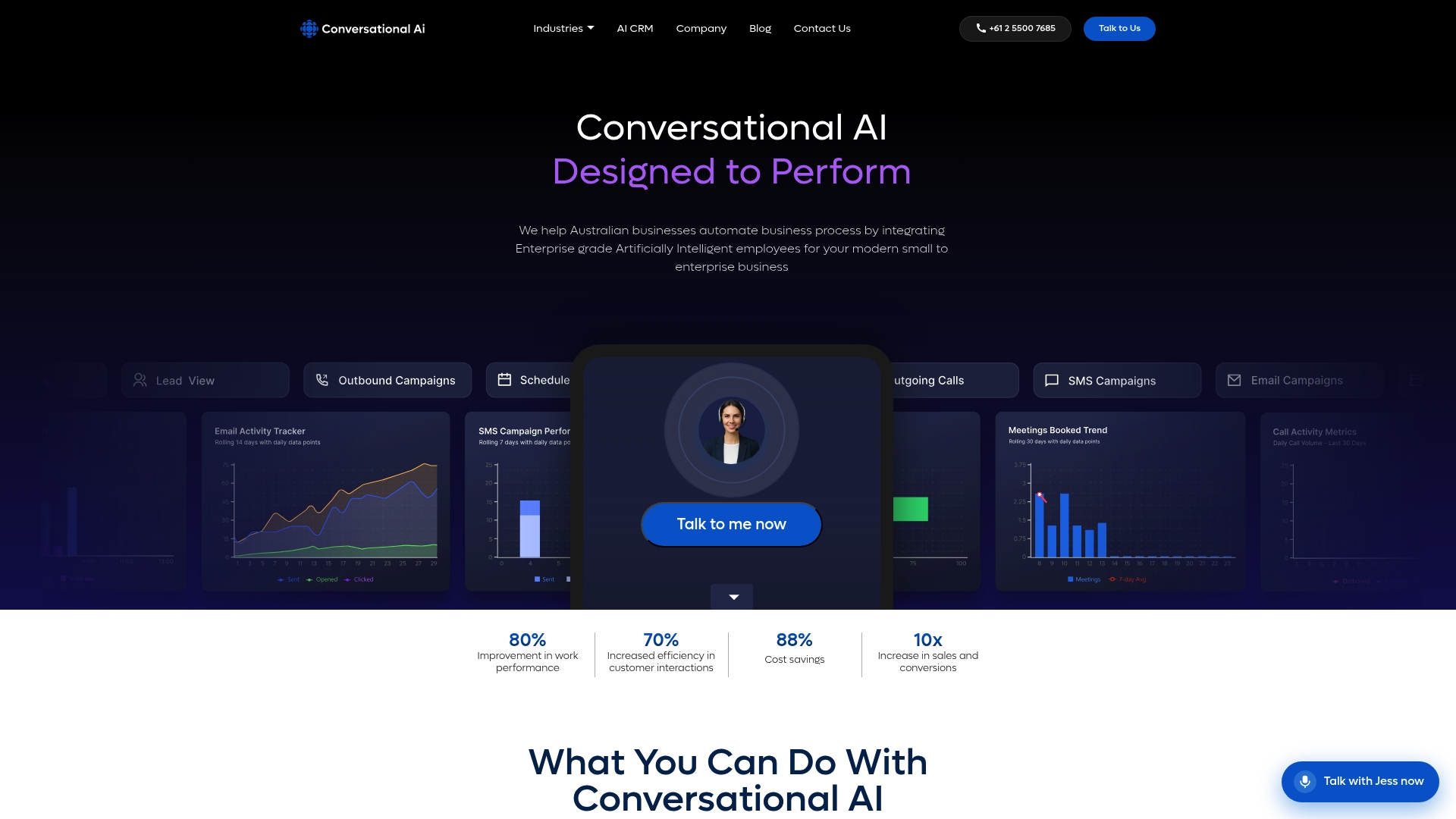
We built Conversational AI for Australian organisations that cannot compromise on privacy. The platform is a private cloud hosted entirely in Australia with SOC 2 certification, native voice AI, CRM integration, contextual memory, automated follow-ups, outbound campaign management, API integrations and white-labelling. Finance teams use it for customer service, lead qualification, appointment booking and collections conversations across voice, SMS, email and chat.
See the banking and finance solution for how these capabilities map to your workflows, or start from the platform overview.
Our perspective
Most finance teams we talk to are not short of AI ideas. They are short of an approach their risk committee can approve. The hard part is rarely the model. It is the questions around it: where does the data sit, who owns the agent, what happens when it is unsure, and can we show all of this to a regulator?
We think the answer starts with sovereignty. When the platform is hosted entirely in Australia, as ours is, the jurisdiction question is settled before it becomes a debate. Add SOC 2 certification, full control over your data and the option of on-premises deployment, and the conversation moves to what the agents should do rather than whether they may be used at all.
The second principle is one record per customer. Voice, SMS, email and chat agents that share your CRM and contextual memory mean a customer who texts in the morning and calls in the afternoon is not asked to start again. It also means staff who take over an escalation see the full history.
Start small, measure honestly and widen the scope as trust builds. That is how the Australian banks have done it, and it is how we help our customers do it.
Sowrabh
FAQ
Is conversational AI the same as a chatbot?
Not quite. Many older finance chatbots are static FAQ tools that return fixed answers. Conversational AI uses language models to understand open-ended requests, keep context and act across voice, SMS, email and chat, with escalation to staff when needed.
Does conversational AI have to be hosted in Australia?
No single rule says so for every business. But the Actuaries Institute framework advises restricting customer data processing to approved jurisdictions, and APRA’s CPS 234 treats AI models, training data and inferences as information assets to be secured. Onshore hosting is the simplest way to meet both.
Can an AI agent give financial advice?
Take care here. Whether a response crosses into regulated financial advice is a live question for Australian institutions, as the scrutiny of CBA’s AI Companion shows. Scope your agents to service, booking and process questions, and escalate anything that looks like a recommendation to a licensed person.
How do we measure return on investment?
Set a baseline before launch, then track containment rate, resolution quality, handle time, after-hours coverage and cost per resolved contact. Pair those figures with customer research so you see failures that numbers hide.
Sources
- KWM and Sapere: The impact of AI on the Australian financial services industry
- Mills Oakley: AI and financial advice, live chatbots and virtual call centres
- Channel Life: CommBank rolls out Microsoft-built customer service AI
- Macquarie: launch of Q
- iTnews: NAB Bot saves bank $1.2 million
- iTnews: NAB sets software bots loose on its email avalanche
- iTnews: CBA’s AI Companion is expected to face some hard questions
- Norton Rose Fulbright: Artificial intelligence in the Australian financial services sector
- ASIC Report REP 798
- IDM: Finance industry warns against restrictive AI regulation
- Actuaries Institute: AI risk management in the financial services sector
- EY: How Australian FS leaders are picking up the pace with generative AI
- Forrester: Conversational AI and anticipatory insights in Australian mobile banking
- ASIC draft Regulatory Guide on providing digital financial product advice
- NAB: Transforming customer experience with Amazon Connect and ML