Cut Days to Payment in One Billing Cycle: SMS Automation for Australia
Australian businesses: implement SMS collections automation to cut days to payment, comply with ACCC and 2026 sender ID rules, and follow a tested...
Collections automation SMS speeds up payments when it is built on the right foundations: verified consent, tight integration with your finance system, and a clear escalation path to a human. Done properly, it lifts read rates well above email and shortens the gap between invoice and payment. Done carelessly, it breaches Australian debt collection rules and burns your sender reputation.
TL;DR:
- SMS collection automation significantly reduces days to payment when paired with verified consent, real-time finance system syncing, and clear escalation to a human.
- Compliance requirements in Australia mandate explicit opt-in, consent record storage, frequency caps, and registered sender IDs, especially ahead of the 2026 anti-scam rule changes.
- Successful KPIs include high click-to-pay rates, improved days-to-payment within a billing cycle, and low escalation rates, with measurement of actual payment completions within 24 hours.
- Building a tech stack with integrated ERP, CRM, and payment gateways is critical, and failures often relate to delayed settlement data, outdated contact information, and link or sequence errors.
- Using specialized platforms like Conversational AI simplifies compliance, consent management, and technical integration, avoiding the heavy internal lift of manual setup.
Table of Contents
- What is collections automation SMS and where does it fit?
- What KPIs actually prove SMS collections automation is working?
- Australian rules every collections SMS program must follow
- Building the tech stack: integrations, sequencing and testing
- What Australian implementations show in practice
- Handling exceptions and disputes triggered by SMS
- Integration challenges and troubleshooting in Australian business systems
- Why the compliance checklist matters more than the clever copywriting
- A compliant way to run SMS collections without building it yourself
- Where to check the rules yourself
- Sources
- FAQ
What is collections automation SMS and where does it fit?
Collections automation SMS uses scheduled and triggered text messages, often paired with a payment link, to chase overdue invoices without a staff member dialling every account manually. It sits inside a broader debt collection chatbot or SMS collections software stack, working alongside email and phone rather than replacing them outright.
Text messages get opened. That single fact is why SMS reminder automation outperforms email for time-sensitive collections work in almost every accounts receivable workflow. People check their phone within minutes of a notification landing; an invoice sitting in an inbox can wait days.
The strongest use cases for an automated debt collection SMS program include:
- Invoice reminders sent a few days before the due date, giving customers a nudge before they’re technically overdue.
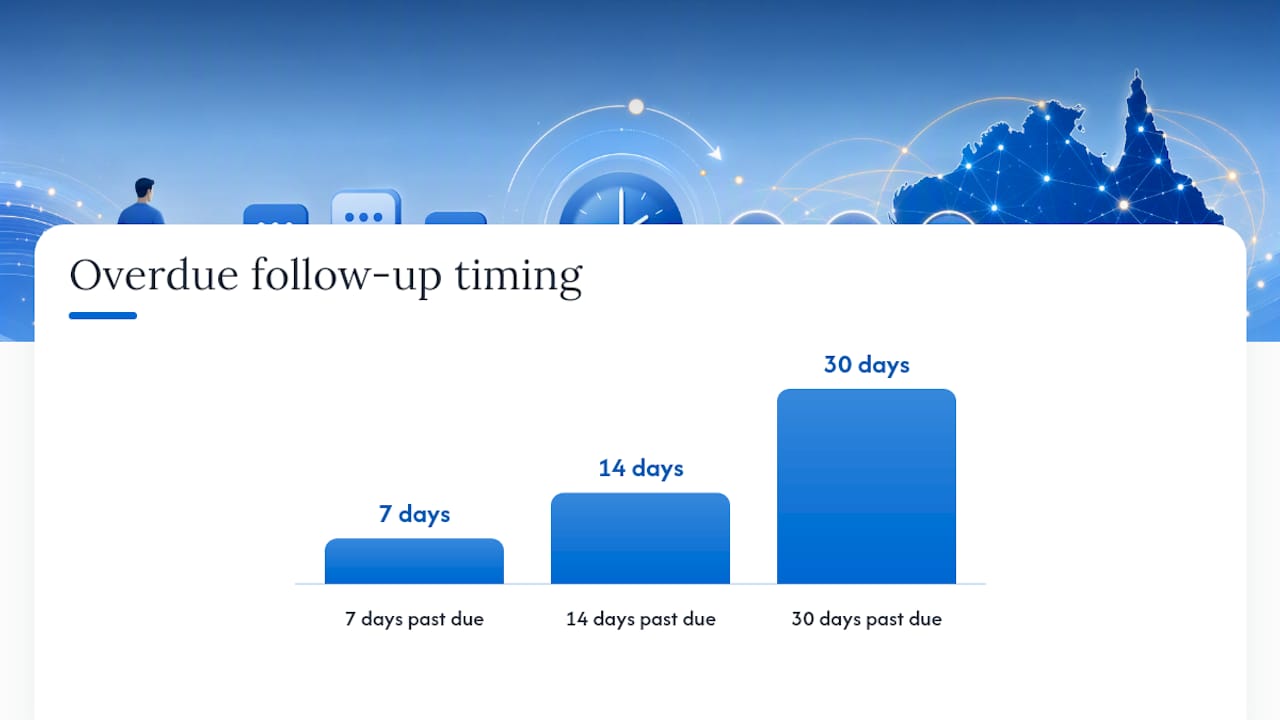
- Overdue follow-ups triggered automatically once an account crosses 7, 14, or 30 days past due.
- Payment links embedded directly in the text, so the customer pays in two taps instead of logging into a portal.
- Payment plan confirmations, where SMS confirms instalment amounts and dates after a negotiated arrangement.
- Two-way dispute triage, where a simple reply like “dispute” or “call me” routes the account to a human agent instead of continuing the automated sequence.
SMS works best for straightforward, transactional nudges. Once an account involves hardship, a genuine billing dispute, or a large commercial balance, pair the text message with a phone call or email that carries more detail. The SMS collection process should always have an exit ramp into human contact, not just an escalation to a sterner message.
What KPIs actually prove SMS collections automation is working?
Five numbers tell you whether an SMS collections program is paying for itself: open/read rate, click-to-pay rate, days to payment, promise-to-pay capture rate, and escalation rate. Track all five, not just the vanity metric of messages sent.
Pro Tip: Don’t just measure whether a message was opened. Measure whether the click on the payment link led to a completed transaction within 24 hours. That gap between click and payment is where a lot of “successful” campaigns quietly leak revenue.
The benchmark that matters: Industry case work on SMS-plus-payment-link workflows shows that pairing a reminder text with a one-tap secure payment collection SMS link can compress days-to-payment from weeks down to days, once the link connects cleanly to your payment processor and accounting system.
Days to payment is the metric your CFO actually cares about. If your average currently sits at 35 days post-invoice, a well-sequenced SMS program should show measurable movement within one billing cycle. Run short A/B pilots first, testing message wording, send time, and cadence on a segment of 200 to 500 accounts before rolling changes out fleet-wide. A two-week pilot window is usually enough to see whether click-to-pay rates shift meaningfully.
Australian rules every collections SMS program must follow
Getting the compliance layer wrong is the fastest way to turn an efficient automated billing SMS service into a liability. The ACCC’s debt collection rules set the tone: contact must be respectful, not excessive, and it must stop for accounts in genuine dispute or hardship until a human resolves the matter.
Six operational controls keep you on the right side of both the ACCC and your carrier:
- Capture explicit opt-in at point of sale, naming collections messaging specifically rather than burying it in generic terms and conditions.
- Store every consent record with a timestamp, tied to the customer account.
- Apply frequency caps by customer segment, so no account receives more than a set number of texts per week regardless of how many sequences are running.
- Automate opt-out acknowledgement, confirming the STOP request and logging it immediately.
- Register your sender ID ahead of the mid-2026 anti-scam rules, which require registered sender identities and can affect deliverability for anyone still sending from unregistered numbers.
- Keep audit logs and host data within Australia, particularly if you operate in banking, healthcare, or another regulated sector.
Country-level regulatory summaries confirm Australia has specific restrictions on message types and consent capture that differ from what you might see in guides written for other markets. Cross-check your program against Australian primary sources, including the Commonwealth legislation register, rather than relying on generic overseas playbooks.
Pro Tip: Write your opt-out confirmation message once, test it, then lock it. Inconsistent opt-out wording across campaigns is one of the most common audit failures we see in collections messaging service reviews.
Building the tech stack: integrations, sequencing and testing
Three systems need to talk to each other before an SMS collections program is safe to switch on: your ERP or finance platform, your CRM, and your payment gateway. Skip any one of them and you risk chasing a customer who already paid, or sending a payment link that doesn’t reconcile automatically.
- ERP/finance system supplies real-time balance and settlement status, so reminders stop the moment a payment posts rather than continuing on a fixed schedule.
- CRM holds contact history and consent records, feeding the sequencing logic so the right customer gets the right message at the right stage.
- Payment gateway generates the secure, trackable link embedded in the text, and confirms back to the finance system when funds clear.
Sequence design should escalate gradually: a friendly reminder before the due date, a firmer nudge at 7 days overdue, a message with a payment plan option at 21 days, and a human handoff trigger at 30 days or on any dispute keyword. Templates should stay short, specific, and never threatening, in line with the respectful-contact standard the ACCC sets out.
Before going live, run three checks. Test deliverability across the major Australian carriers. Audit every consent record against your opt-in capture process. And confirm your payment links meet the security standards your gateway provider requires. Practitioners building production debt collection chatbots warn that SMS bots need rigorous testing against real, messy replies before they’re trusted with live accounts. A firm like 121 Group can help professional services businesses map these integrations if the build sits outside your internal capability.
What Australian implementations show in practice
SMS automation’s biggest measurable win outside collections is a useful proxy for what it can do inside collections. For example, one case study found SMS appointment reminders cut no-shows by 35% for an Australian business, purely by getting a timely, easy-to-act-on message in front of someone at the right moment. The same mechanic drives collections throughput: a reminder that lands, reads clearly, and offers an immediate action point converts more often than a static invoice sitting unopened.
A repeatable seven-step multichannel setup, originally built for automating follow-ups across sales teams, maps almost directly onto collections: define triggers, sequence channels, set escalation rules, log every touch, and route exceptions to a human without delay.
Data residency matters here too. Hosting collections messaging and audit logs within Australia remove a layer of friction for compliance teams in banking, healthcare, and finance, where auditors expect to see exactly where customer data sits.
Handling exceptions and disputes triggered by SMS
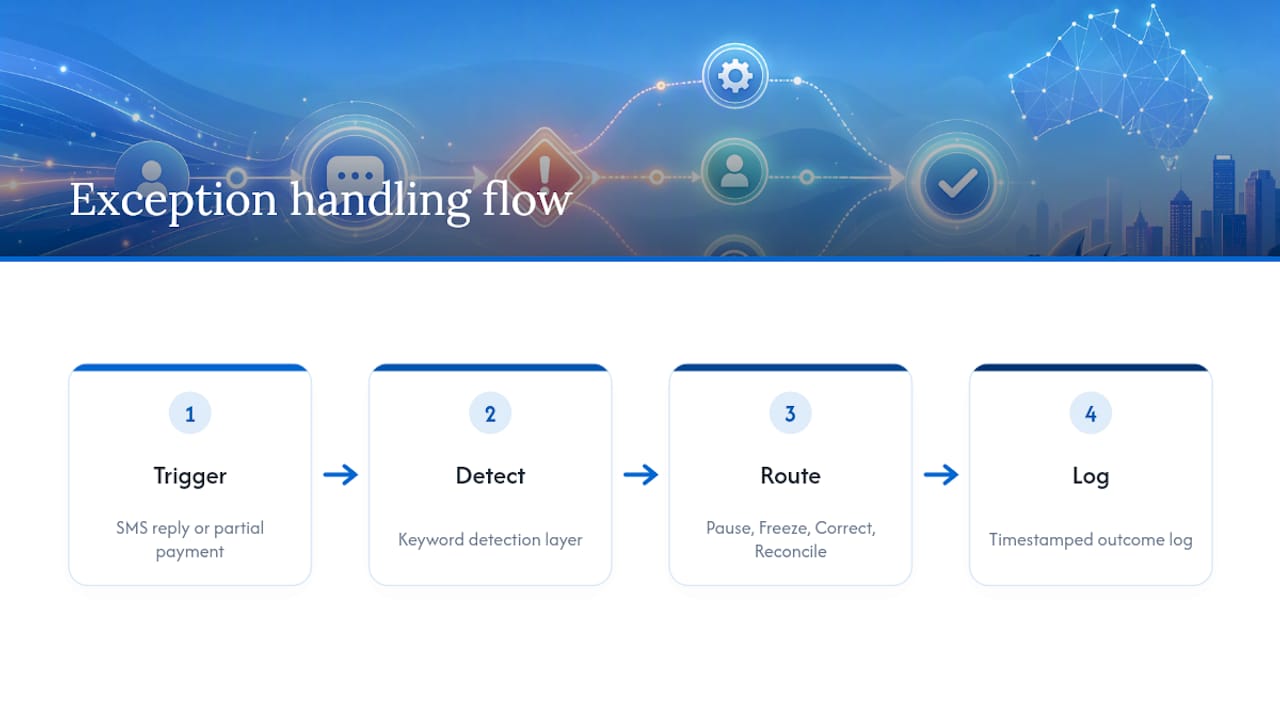
Every SMS collections program eventually gets a reply it didn’t expect, and how you handle that reply matters more than how many messages you send. A customer texting back “I already paid this” or “this isn’t right” needs to stop the automated sequence immediately, not receive another reminder three days later because the system didn’t register the exception.
Build a keyword-detection layer that recognises common dispute language, hardship signals, and simple confusion, then route each to the right outcome. A hardship claim needs a human conversation, ideally within one business day, and the ACCC’s guidance is explicit that automation should pause the moment a case moves into dispute or hardship territory. A billing error needs the account frozen from further reminders until finance confirms the correct balance. A wrong-number reply needs the contact record corrected, not just the reminder cancelled.
The riskiest exception is silence combined with a payment discrepancy: a customer who pays part of an invoice, then stops responding. Without real-time reconciliation between your payment gateway and finance system, the automated sequence keeps chasing the full amount, which reads as harassment even when it’s a technical oversight rather than intent. Log every exception with a timestamp and outcome. This log is what protects you in an ACCC complaint or an internal audit, and it’s the difference between a defensible automated process and one that looks careless the moment someone asks questions.
Integration challenges and troubleshooting in Australian business systems
Most SMS collections failures trace back to a handful of predictable integration gaps, and knowing them in advance saves weeks of firefighting after launch.
The most common issue is delayed or missing settlement data from the finance system. If your ERP updates account balances in a nightly batch rather than in real time, customers who pay late in the day still receive a reminder the next morning, which damages trust fast. Push for real-time or near-real-time syncing wherever your finance platform supports it, even if that means a middleware layer between systems that weren’t built to talk to each other.
A second issue is CRM contact data going stale. Phone numbers change, especially for small business customers, and a message sent to a disconnected number doesn’t just fail silently, it can flag your sender ID with carriers if bounce rates climb. Build a periodic contact-validation step into your workflow rather than assuming CRM data stays accurate.
Payment link failures are the third recurring headache, usually caused by session timeouts or gateway mismatches between the SMS platform and the payment processor. Test the full click-to-confirmation loop on every carrier network, not just Wi-Fi, since mobile data conditions expose timing issues that don’t show up in a desk test.
Finally, watch for sequence collisions, where a customer sitting in both a collections sequence and a general marketing campaign gets double-messaged. Centralise messaging rules across departments so collections always takes priority and suppresses unrelated campaigns for that contact.
Why the compliance checklist matters more than the clever copywriting
Most advice on collections messaging focuses on wording, tone, and send times, and that’s fine as far as it goes. It misses the bigger risk. The businesses that get burnt by SMS collections automation aren’t the ones with mediocre message copy, they’re the ones that skipped consent capture, ignored frequency caps, or didn’t build a real escalation path before switching the system on.
The conventional advice treats compliance as a checkbox to tick after the “real” automation work is done. That ordering is backwards. Consent records, opt-out logging, and human-in-the-loop rules for disputes should be built first, because retrofitting them onto a live sequence that’s already texting thousands of customers is far harder than designing them in from day one.
If there’s one priority for an accounts receivable team starting this now, it’s the sender ID registration deadline arriving with the 2026 anti-scam rules. Deliverability problems from an unregistered sender ID will quietly erode a program’s read rates long before anyone notices the compliance gap. Fix the plumbing before you polish the message.
— Sowrabh
A compliant way to run SMS collections without building it yourself
Running SMS collections automation properly means owning consent records, real-time ERP syncing, sender ID registration, and human escalation, all at once, which is a heavy lift for most internal IT teams. Conversational AI is built specifically for Australian businesses that need this without the multi-month integration project. The platform hosts entirely within Australia, aiding regulated sectors with data residency and audit trails auditors require.
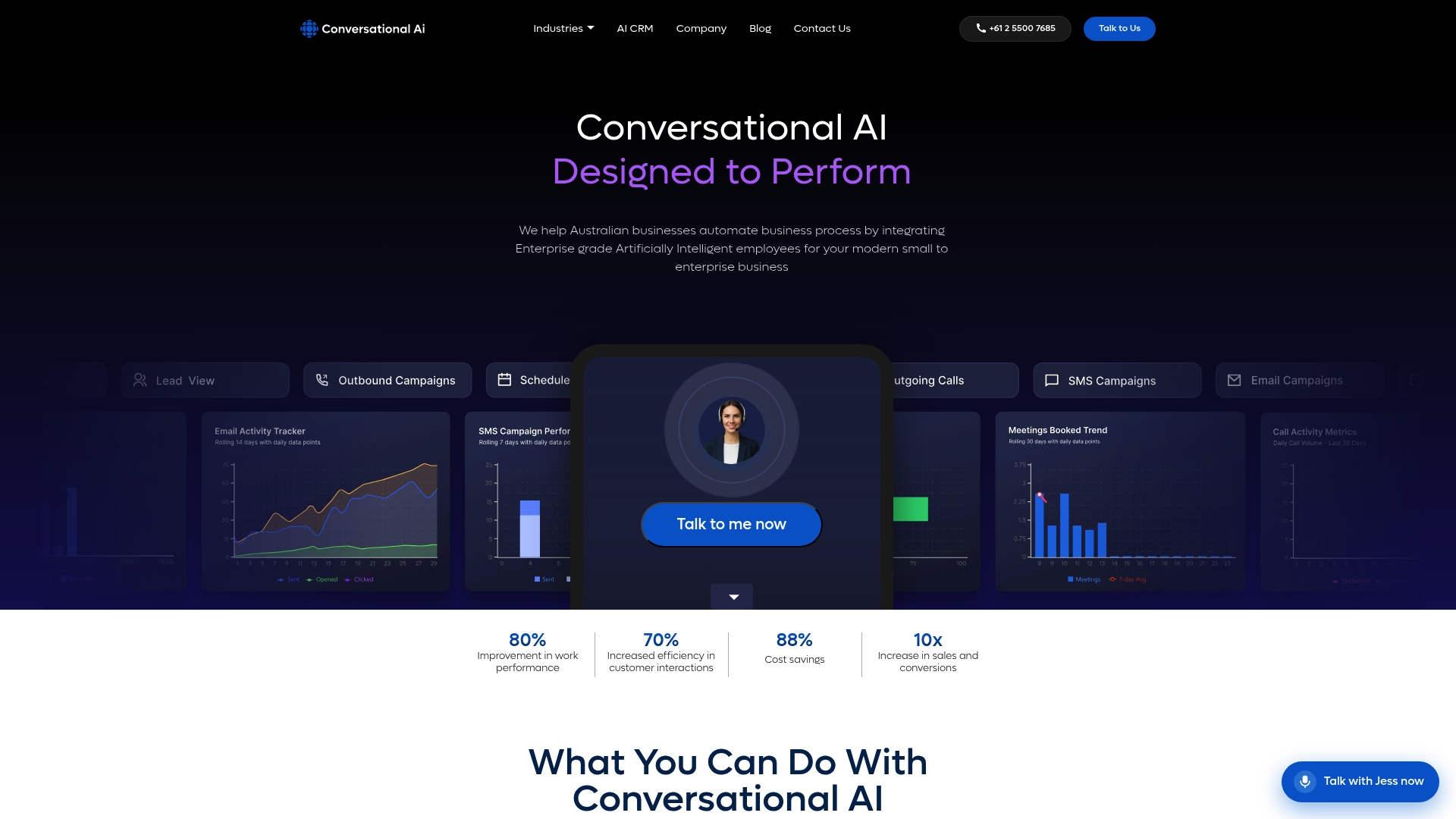
The Conversational AI for Debt Collection offering connects SMS agents directly to payment link orchestration, CRM history, and a genuine human handoff for disputes or hardship cases, so accounts never get stuck in an automated loop when they shouldn’t be. The underlying Conversational AI CRM keeps contact records, consent, and escalation rules in one system rather than scattered across three platforms that don’t talk to each other. If your finance team is ready to see how this fits your existing ERP and payment gateway, book a demo through Conversational AI and walk through your specific workflow with the team.
Where to check the rules yourself
Sources
- Debt collection rules — ACCC
- Commonwealth legislation — Australian Government
- Australia SMS regulations and restrictions — Clickatell
FAQ
What is the best bulk SMS service in Australia?
There’s no single best provider for every business. Prioritise Australian sender ID support, transparent delivery reporting, and local support, criteria comparison guides for Australian bulk SMS providers generally use, and confirm the provider integrates cleanly with your ERP and CRM.
What are the new SMS rules in Australia for 2026?
From 1 July 2026, new anti-scam rules require registered sender IDs for business text messages, with deliverability consequences for anyone sending from an unregistered identity.
Is there a free SMS gateway for collections messaging?
Free gateways exist but rarely support the consent logging, frequency caps, and audit trails Australian debt collection compliance requires, so most accounts receivable teams outgrow them quickly.
Does SMS collections automation actually work for Australian businesses?
Yes, when it’s built on verified consent, real-time account syncing, and a clear human escalation path. Platforms like Conversational AI pair SMS agents with CRM and payment integration specifically to meet these conditions for Australian enterprises.