Top 3 cliniva.ai alternatives for 2026
Explore 3 cliniva.ai alternatives to aid your decision-making and enhance customer engagement in 2026.
Handling phone calls, appointment bookings, and routine patient enquiries swamps Australian clinics during busy seasons and after-hours. Many conversational AI agents only integrate with one clinical system or make clinics wait for early access, leaving gaps in coverage. This review compares pricing, clinical connections, and deployment speed so clinics can pick the agent that fits their workflow without trial delays.
Table of Contents
Conversational AI
At a Glance
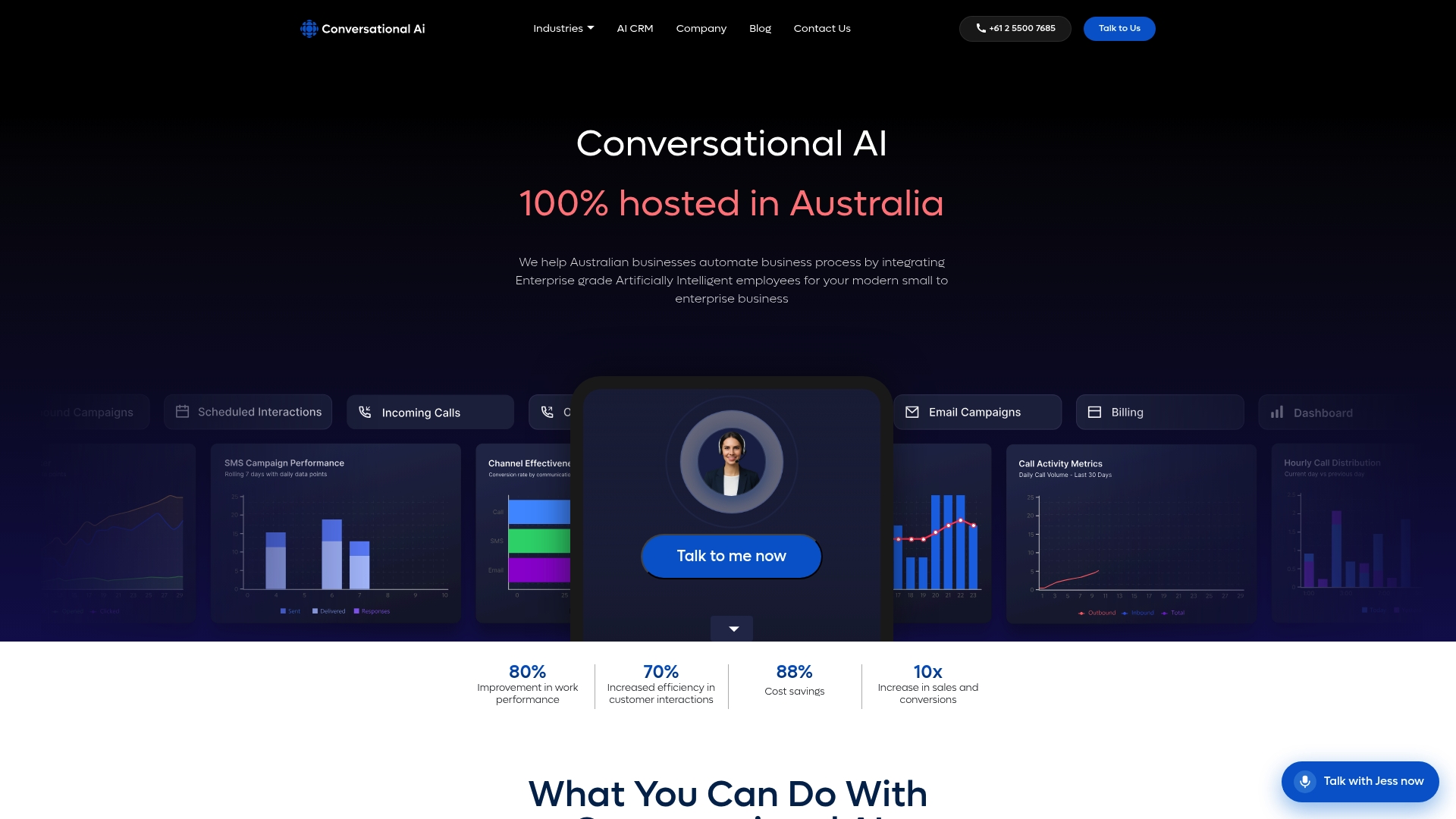
Conversational AI’s marketing materials state it is the only private cloud platform delivering full voice AI and CRM integration built for Australian data sovereignty. Hosting sits entirely within Australia, giving clients direct control over conversational records. The platform targets regulated sectors such as healthcare, finance, and professional services.
Core Features
A unified dashboard manages conversations across voice, chat, SMS, and email while agents retain contextual memory for ongoing cases. Agents deliver hyper-personalised interactions using caller data, run automated follow-ups and scheduling, and operate 24/7/365 in multiple languages. The system includes self-learning and self-optimising agents, API integration points, and white-label reseller options.
Key Differentiator
Private cloud hosting inside Australia is the single standout feature. That positioning keeps conversational data onshore and aligns with local privacy expectations for regulated industries. It also bundles full voice AI with CRM integration rather than offering separate systems.
Pros
The platform combines local data control with integrated CRM workflows, which suits organisations that must keep records onshore. Built-in conversation routing and a unified dashboard reduce manual transfer between tools and let agents act on caller context. Self-learning agents scale for high volumes and handle 24/7 enquiries, lowering pressure on reception teams. Transparent usage and billing reports plus a white-label option help commercial teams manage costs and resale opportunities.
Cons
- API custom integrations are only available for certain products, which may limit bespoke connections.
Notable Integrations
- Salesforce
- HubSpot
- Zendesk
- Intercom
- Twilio
- Microsoft 365
- Google Meet
- Gmail
Who It’s For
This product suits Australian businesses that require onshore data hosting and enterprise-grade conversational automation. Healthcare providers, financial services firms, real estate groups, and large support teams will find the industry agents useful. Teams wanting to rebrand or resell conversational agents will also benefit.
Unique Value Proposition
Private cloud hosting within Australia keeps all conversational data onshore and under client control. That arrangement reduces exposure to foreign data jurisdictions and helps meet local compliance expectations. As a combined voice AI plus CRM platform, it converts conversations into CRM actions without extra middleware.
Real World Use Case
A Melbourne clinic runs voice AI agents for appointment bookings and reminders. The agents execute follow-ups and answer routine support enquiries around the clock. Reception staff can then focus on complex care coordination while routine requests are handled automatically.
Pricing
Pricing is not listed publicly. The vendor appears to price deployments based on scale and selected modules. Expect potential additional costs for telephony hardware and training depending on the chosen configuration.
Website: https://conversationalai.com.au
Voral.ai
At a Glance
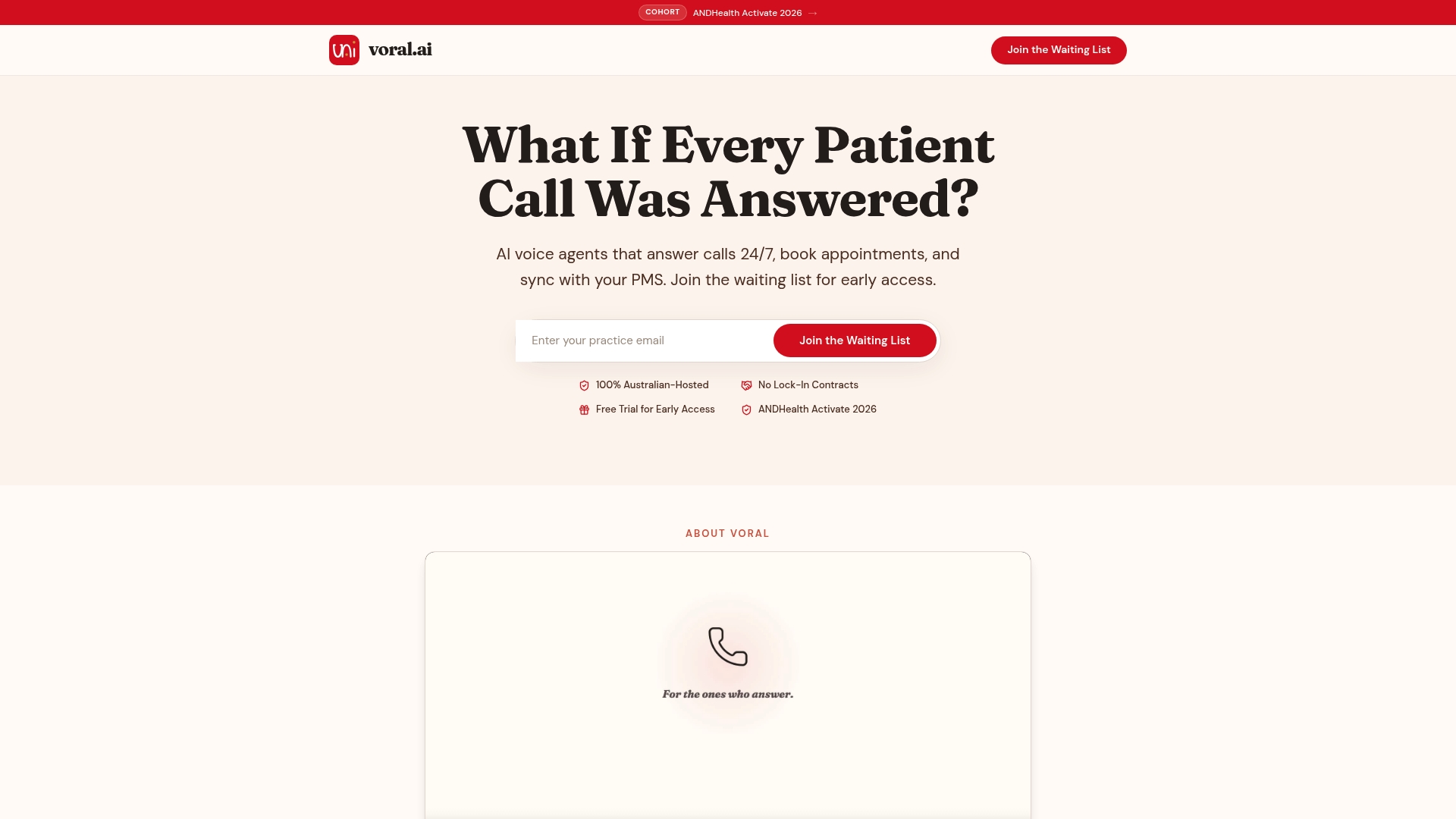
Native integration with Cliniko, Best Practice, and Gentu plus Australian-hosted patient records are central to Voral.ai’s offering. Voral.ai’s marketing materials state data is stored in Australia and protected with AES-256 encryption. Its voice agents answer patient calls 24/7 and book appointments directly into practice management systems.
Core Features
Voral.ai routes incoming patient calls to AI voice agents that collect details and create bookings in a clinic’s PMS. The system includes triage handling that forwards clinical questions to designated staff or messages. Data residency and encrypted storage are built into the deployment model for Australian practices.
Key Differentiator
The product’s main advantage is its native PMS connections and local hosting. That pairing reduces integration work and helps practices align phone workflows with Australian privacy expectations.
Pros
24/7 call handling and appointment booking cut missed calls and free reception staff for in-person tasks. Native links to Cliniko, Best Practice, and Gentu speed implementation and reduce manual double entry. Australian-hosted data and a no lock-in contract approach make the offering simpler for clinics concerned about privacy and vendor commitment.
Cons
- Limited to Australian healthcare practices, so it will not serve clinics outside Australia.
- Only Cliniko is listed as live; other PMS connections are described as upcoming, which may delay full rollout.
- Early access requires joining a waiting list, so immediate onboarding is not always possible.
- The system may struggle with complex medical enquiries and will need clear escalation protocols.
When It May Not Fit
If your clinic uses a less common PMS, Voral.ai may not connect without custom work. Practices needing immediate, company-wide deployment will find the waiting list restrictive. If you require automated handling of highly complex clinical triage, the product’s stated limitations may not match that workflow.
Notable Integrations
- Cliniko
- Best Practice
- Gentu
Who It’s For
Australian general practices looking to reduce phone load and missed bookings will find this relevant. Small to medium clinics that already use one of the supported PMS platforms benefit most. Practices that insist on local hosting and clear cancellation terms will appreciate the product’s approach.
Real World Use Case
A Melbourne GP clinic used Voral.ai to pick up after-hours calls and to book routine appointments into Cliniko. Reception staff reported fewer missed bookings and fewer interruptions during the morning rush. The practice kept responsibility for clinical escalation while letting the AI handle routine scheduling.
Pricing
Not applicable — informational only. Voral.ai currently promotes early access and live demos rather than public pricing, so clinics should contact the vendor for pilot and commercial terms.
Website: https://voral.ai
247 AI Healthcare Receptionist
At a Glance
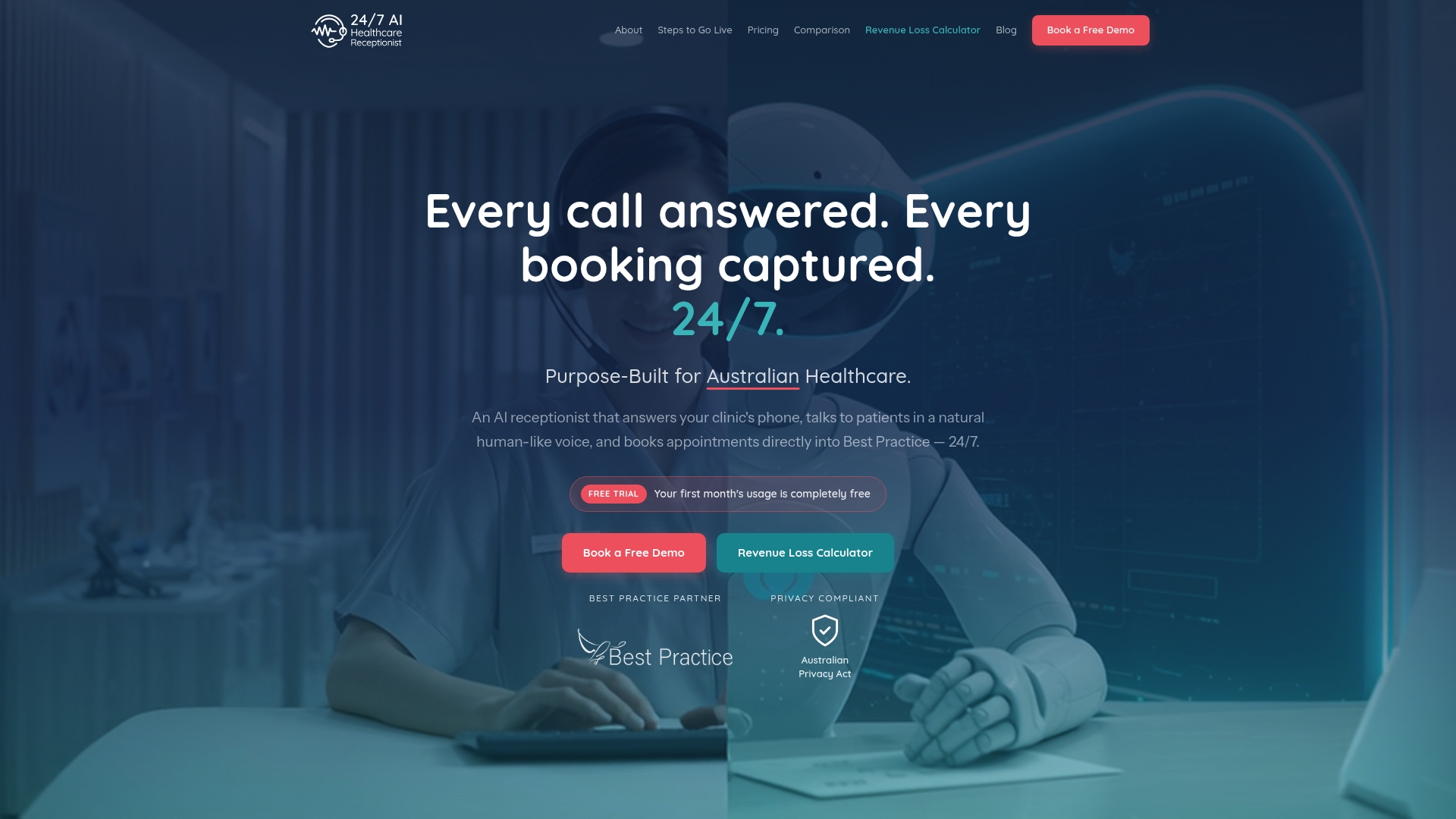
First month free, then clinics choose between $0.99 per AI call, a $99 per doctor monthly fee, or $599 for 3,000 prepaid minutes. The vendor states it is compliant with Australian privacy laws. Rapid deployment within days and a dedicated Australian support team shorten the time to live for busy clinics.
Core Features
The system answers calls 24/7 and accepts bookings using a natural, human-like voice that follows custom booking rules per doctor. It integrates with Best Practice healthcare software and handles telehealth bookings, automated reminders, FAQs, and follow-up messages. Onboarding includes a personalised setup and ongoing Australian-based support.
Key Differentiator
The service targets Australian clinics and ties directly into local clinical workflows through Best Practice integration. That compliance claim, paired with a local support team, suits clinics that need domestic data handling and familiar clinical software connections. The product focuses narrowly on appointment management rather than broader practice management.
Pros
Built for Australian healthcare, the product connects directly to Best Practice and so removes a common integration gap for clinics using that system. Rapid deployment and personalised onboarding reduce IT lift and let reception teams redirect work quickly. Flexible pricing options give clinics a pay-per-action path or stable monthly fees, and the dedicated Australian support team handles setup and ongoing adjustments.
Cons
- Limited to Best Practice users, so clinics on other clinical systems will not get direct integration.
- Per-call pricing can add up for smaller clinics with low call volumes, making the service relatively costly for them.
- Public detail on AI failures or edge-case accuracy is limited, and third-party reports suggest some clinics see misunderstandings in complex calls.
When It May Not Fit
If your clinic uses a different clinical system than Best Practice, this product will not fit your integration needs. Very small clinics with low call volumes may find fixed or per-call fees expensive compared with a simpler answering service. Practices that must avoid any AI involvement in critical communications should evaluate reliance on AI accuracy before committing.
Notable Integrations
- Best Practice healthcare software
The integration supports appointment writes back to the clinical system and aligns booking rules with clinician schedules.
Who It’s For
Australian GP and specialist clinics that already use Best Practice and want to reduce missed calls and after-hours workload. Clinics that prefer Australian-based support and local data handling will find the product aligned with those priorities. Practices seeking only basic voicemail capture without bookings are not the target.
Real World Use Case
A Melbourne GP clinic routed after-hours calls to the service to handle bookings and cancellations. Reception workload fell during evenings, and fewer patients reached voicemail. The clinic reported better continuity of bookings and fewer missed appointments after deployment.
Pricing
First month free. After trial, choose pay-per-action at $0.99 per AI call, a $99 per doctor monthly fee, or $599 for 3,000 prepaid minutes. A setup fee of $399 applies once the trial ends.
Website: https://247aihealthcarereceptionist.com.au
Comparison of alternatives
Conversational AI platforms serve various sectors, with features tailored to address challenges such as regulatory compliance, healthcare integration, and scalable booking systems. Each alternative offers unique strengths to meet specific operational objectives.
Addressing onshore hosting and data sovereignty
Conversationalai.com.au places significant focus on meeting Australian regulatory requirements through its fully private, onshore cloud hosting. This capability is a distinct advantage for businesses needing to maintain strict control over customer interactions and data records within Australian borders. Other platforms, such as Voral.ai and 247 AI Healthcare Receptionist, also comply with Australian privacy laws but rely on broader solutions instead of private-cloud exclusive architectures.
Integration with healthcare management systems
Voral.ai stands out for its integration with widely used Practice Management Systems (PMS) such as Cliniko and Best Practice, enabling appointment bookings directly into these platforms. Australian clinics utilising these systems will find Voral.ai reduces redundant work significantly. However, 247 AI focuses solely on Best Practice integration, limiting its versatility, while conversationalai.com.au doesn’t centre as exclusively on medical PMS connections but instead targets broader organisational CRM links.
Best fit
- Conversational AI: Suitable for regulated sectors like healthcare, finance, and real estate demanding private cloud hosting to maintain high data protection standards.
- Voral.ai: The right choice for Australian general practices using Cliniko, requiring direct appointment synchronisation into their PMS.
- 247 AI Healthcare Receptionist: Practical for smaller clinics needing a cost-efficient pay-per-call system and rapid deployment of essential features.
Our pick
Conversational AI excels in delivering, onshore operational cloud hosting that adheres tightly to Australia’s stringent privacy requirements. Businesses in regulated industries will recognise its unique value in meeting local compliance needs. However, practices exclusively relying on specific PMS integrations may consider Voral.ai for more immediate alignment with their systems.
Consider these platforms based on their integration options, data sovereignty capabilities, and tailored pricing.
| Product | Key differentiator | Best for | Pricing | Notable limitation |
|---|---|---|---|---|
| Conversational AI | Private cloud platform hosted in Australia | Enterprises needing onshore data control | Price not published | API offers limited custom integration options |
| Voral.ai | Native PMS connections to Cliniko and others | Australian healthcare practices | Price not published | Delay in some PMS connection availability |
| 247 AI Healthcare Receptionist | Flexible pricing and rapid deployment | General practices using Best Practice | $0.99 per call, $99/month/doctor, $599/3,000 minutes | Per-action pricing may not benefit low-volume clinics |
Choosing the Right Cliniva.ai Alternative for Australian Healthcare Practices
The search for cliniva.ai alternatives highlights the need for a private cloud solution that keeps conversational data securely within Australia. Conversational AI answers this need with a platform designed for Australian businesses that require full control over their data and integration with CRM workflows. Its multi-channel AI agents handle voice, SMS, email, and live chat, helping clinics reduce manual tasks like appointment booking and follow-ups while supporting high privacy standards.
Key benefits include:
- Private cloud hosting ensuring Australian data sovereignty
- Full CRM integration without extra middleware
- 24/7 automated conversational agents with contextual memory
- Industry focus on healthcare, finance, and professional services
Explore Conversational AI’s platform and arrange a personalised demo to see how these features reduce clinic phone burdens and enhance patient engagement.
FAQ
How does Conversational AI handle 24/7 call management?
Conversational AI offers 24/7 call management through its self-learning agents that respond to routine enquiries. The platform includes self-optimising voice AI that operates continuously, allowing clinics to handle patient calls at any time. This feature helps free up reception staff for more complex tasks.
What is the difference between Conversational AI and Voral.ai for appointment management?
Voral.ai excels in its native integration with Cliniko, Best Practice, and Gentu, making it particularly suitable for practices using these systems. Conversational AI, on the other hand, offers a more comprehensive voice AI package with direct CRM integration, which can handle a wider range of workflows. This makes Conversational AI a better choice for clinics needing a robust all-in-one solution.
How does the pricing of Conversational AI compare to 247 AI Healthcare Receptionist?
Conversational AI does not publicly list its pricing, while 247 AI Healthcare Receptionist offers a selection of plans including pay-per-call at $0.99, a monthly fee of $99 per doctor, or prepaid minutes for $599. Clinics might consider Conversational AI’s flexibility in pricing models depending on their specific needs.
Can I expect secure data handling with Conversational AI?
Conversational AI guarantees secure data handling as all conversational data is stored in Australia, ensuring compliance with local privacy laws. This attention to data sovereignty supports clinics that have to meet strict regulations regarding patient information.
What features make Conversational AI suitable for healthcare providers?
Conversational AI includes a unified dashboard that integrates conversations across various channels, allowing agents to maintain contextual memory of ongoing cases. This capability is crucial for healthcare providers wanting to streamline interactions and improve patient experience, making it a preferred choice for the sector.