Azure regions in Australia: APP 8 and APRA for conversational AI
Choose Azure regions in Australia or sovereign on premises for AI. Keep recordings and transcripts onshore to meet APP 8 and APRA.

For conversational AI handling regulated data, a sovereign private cloud or on-premises deployment gives the strongest assurance, with a well-configured Australia-hosted enterprise cloud acceptable for lower-risk use cases. The reason comes down to jurisdictional control: Australian Privacy Principle 8 puts the onus on you to stop overseas recipients breaching Australian privacy law, and that’s a much easier promise to keep when the recordings and transcripts never leave the country. Skip to the assessment checklist below if you’re ready to start vetting providers.
TL;DR:
- On-premises and private cloud hosting provide the highest control for sensitive data like health records and financial disputes, with on-premises offering the strongest assurance.
- Verify a provider’s jurisdiction, certifications, operational transparency, and subcontractor details before committing, especially ensuring data residency and sovereign control are explicitly stated.
- Data ingestion, inference, and storage should be designed to occur entirely onshore, with solutions like local models or inference proxies preferred for sensitive workflows.
- Australian law relies more on sovereignty than residency, making local ownership and governing law critical for compliance in regulated industries.
- Combining technical controls with contractual safeguards, such as customer-managed encryption keys and explicit residency clauses, is essential to maintain sovereignty and security.
Table of Contents
- What hosting model suits sovereign conversational AI?
- What should you verify before signing with a provider?
- How do you keep conversational data onshore in practice?
- What contract clauses should procurement demand?
- Why does Australian regulation push toward sovereign hosting?
- Prioritise controls, not just location
- Where does Conversational AI fit for enterprises building onshore?
- Where to verify this further
- Sources
- FAQ
What hosting model suits sovereign conversational AI?
The right model depends on how sensitive your conversational data actually is, not on what’s cheapest to deploy. Four options dominate the Australian market, and all hands control to a different party.
- On-premises: Your organisation owns and operates the infrastructure. Highest assurance, highest overhead. Best for health records, financial disputes, and anything a regulator would ask you to produce logs for.
- Private cloud: A dedicated, single-tenant environment run by an Australian provider. You get contractual control over retention, disposal, and access without owning the tin.
- Sovereign cloud: Multi-tenant infrastructure owned and operated under Australian jurisdiction, with staff, subcontractors, and governing law all local.
- Public cloud with controls: Hyperscaler infrastructure hosted in an Australian region, hardened with customer-managed encryption keys and region locks.
For call transcription onshore workflows involving patient details, banking disputes, or debt recovery scripts, private cloud or on-prem is the safer default. General customer service enquiries with no personal identifiers can often run on a well-controlled public cloud tier. The mistake most IT teams make is treating “hosted in Australia” as a single category, when it actually spans four very different risk profiles.
What should you verify before signing with a provider?
Sovereignty claims are cheap to make and expensive to get wrong. Before shortlisting any provider for conversational AI hosting, work through this checklist.
- Parent-company jurisdiction. Check where the ultimate parent entity is incorporated and what foreign laws could compel data access. Australian residency doesn’t guarantee sovereignty if a US parent company remains exposed to extraterritorial legal requests.
- Certifications and evidence. Ask for current IRAP assessments, DTA hosting certification status, ISO/IEC 27001 certificates, and SOC 2 reports, not just marketing claims that they’re “compliant.”
- APRA-relevant controls. If you’re in banking or insurance, confirm the provider understands outsourcing obligations under APRA’s prudential standards.
- Technical controls. Region locks, customer-managed encryption keys, immutable logs, and clear rules on who can access forensic data and under what circumstances.
- Operational transparency. Get the full subcontractor list, confirm where support staff physically sit, check backup site locations, and read the incident response SLA line by line.
Pro Tip: Ask providers to name their subcontractors in writing, not just describe their own controls. A sovereign primary contract is worthless if the backup provider they use for disaster recovery sits offshore.
Analysts increasingly stress that provider ownership and governing law matter as much as physical location — a lesson worth repeating to anyone who assumes an Australian address settles the question.
How do you keep conversational data onshore in practice?
Architecture decisions matter more than contract language once a system is live, and engaging an experienced AI Agency Australia can ensure robust implementation and integration of these systems. Design your data flows so ingestion, inference, and storage all happen onshore, with egress blocked by default rather than allowed by exception.
- Ingestion and inference: Route voice and chat input through Australian infrastructure, and run inference on locally hosted models or an inference proxy rather than calling an offshore API.
- Model hosting choices: Private LLMs deployed in Australia suit most enterprise cases; on-prem deployment suits the small number of workloads where even a sovereign cloud vendor’s remote access is too much risk.
- RAG pipelines for sensitive transcripts: Onshore inference paired with a document store that stays on-prem or in a sovereign cloud prevents call recordings or patient notes leaking out through a retrieval step nobody thought to audit.
- Connectivity: Dedicated links reduce the latency penalty of keeping everything local, and ongoing monitoring should flag any unexpected outbound traffic immediately.
- Retention and deletion: Set clear, enforced windows for how long transcripts, recordings, and derived summaries persist, with automatic deletion rather than a policy nobody checks.
Feeding patient data into a model counts as a disclosure under the Privacy Act, so healthcare deployments need particular care around de-identification before anything touches a training pipeline.
What contract clauses should procurement demand?
RFPs for conversational AI hosting should force vendors to answer in specifics, not slogans. Build these into the contract, not just the sales conversation.
- Explicit residency clauses. The contract states Australian data residency in writing, with no carve-out for “processing” happening offshore even briefly.
- A proper DPA. A data processing agreement covering breach notification timelines, sub-processor approval rights, and a ban on foreign legal access without an Australian court order first.
- Technical proof points. Ask for evidence of customer-managed key support, region locking configuration, and recent third-party audit reports, not just a compliance checklist ticked by the vendor themselves.
- Operational disclosures. Staff residency, subcontractor approval processes, and a sample incident runbook you can actually read before signing.
Score each vendor against sovereignty, security, and operational fit separately. A provider that scores well on paper but fails the subcontractor disclosure question should drop down your shortlist fast.
Why does Australian regulation push toward sovereign hosting?
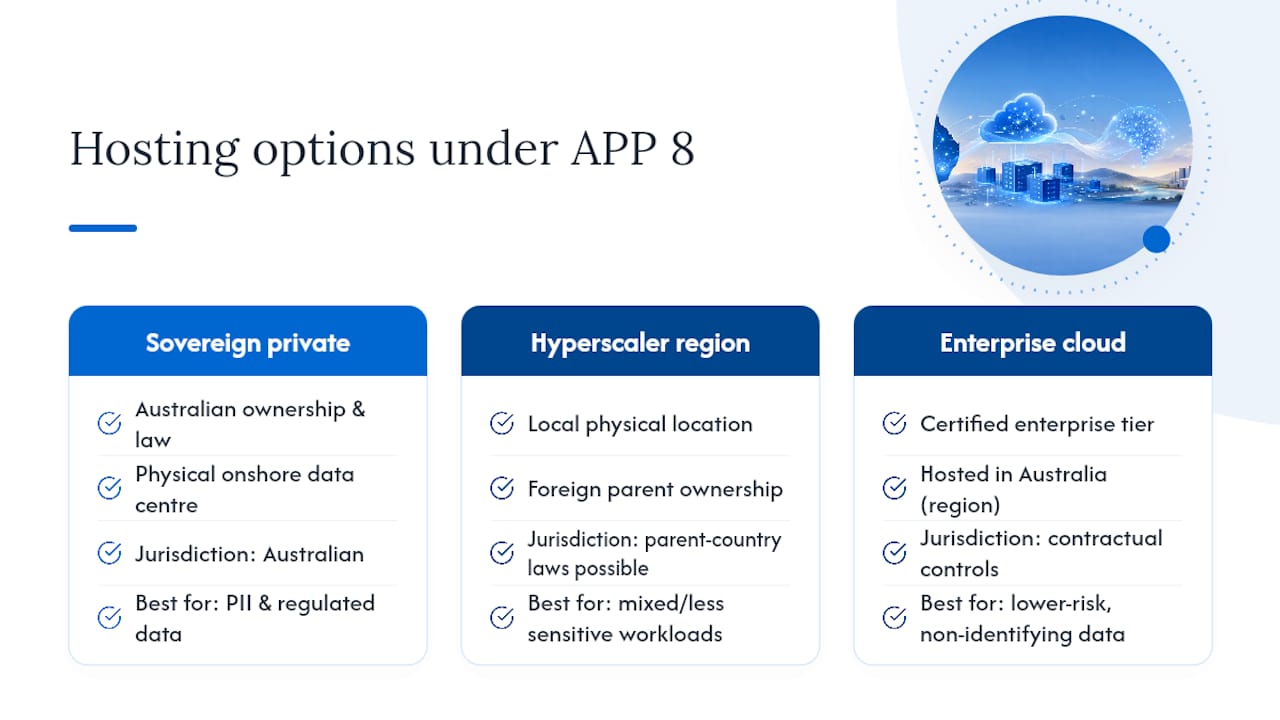
Australian law contains no blanket rule forcing every business to store data onshore. In practice, organisations in banking, insurance, and healthcare increasingly treat onshore hosting as essential because APP 8 and sector-specific rules make the alternative harder to defend.
Residency and sovereignty aren’t the same thing. A data centre physically sitting in Sydney or Melbourne, run by NextDC, AUCloud, Macquarie Cloud Services, or Vault Systems, offers Australian ownership and governing law alongside the physical location. A hyperscaler’s Australian region gives you the address without necessarily giving you the jurisdiction, since the parent company’s home-country laws can still apply.
The most defensible approach classifies conversational data by sensitivity: PII-heavy and regulated workflows sit on sovereign private infrastructure, while lower-risk, non-identifying interactions can run on a certified enterprise cloud tier without the same overhead.
Prioritise controls, not just location
Treat this as a staged project, not a single migration event. Map where your conversational data actually flows today, run a pilot on sovereign onshore infrastructure, audit it against APP 8 and any sector-specific rules, then roll out wider once the pilot holds up.
Contractual promises and technical controls need each other. A DPA without customer-managed keys is unenforceable in practice; encryption without a contract is unenforceable in court. And don’t assume ticking “Australian region” on a hyperscaler console settles sovereignty. It settles residency, which is a different, narrower question.
— Sowrabh
Where does Conversational AI fit for enterprises building onshore?
Certain conversational AI platforms are designed for organisations seeking clear assurance about where their voice, chat, SMS, and email interactions are processed. Some platforms run entirely within Australia, designed to give healthcare, finance, and professional services teams control over recordings, transcripts, and contextual memory rather than relying on offshore parent company policies.
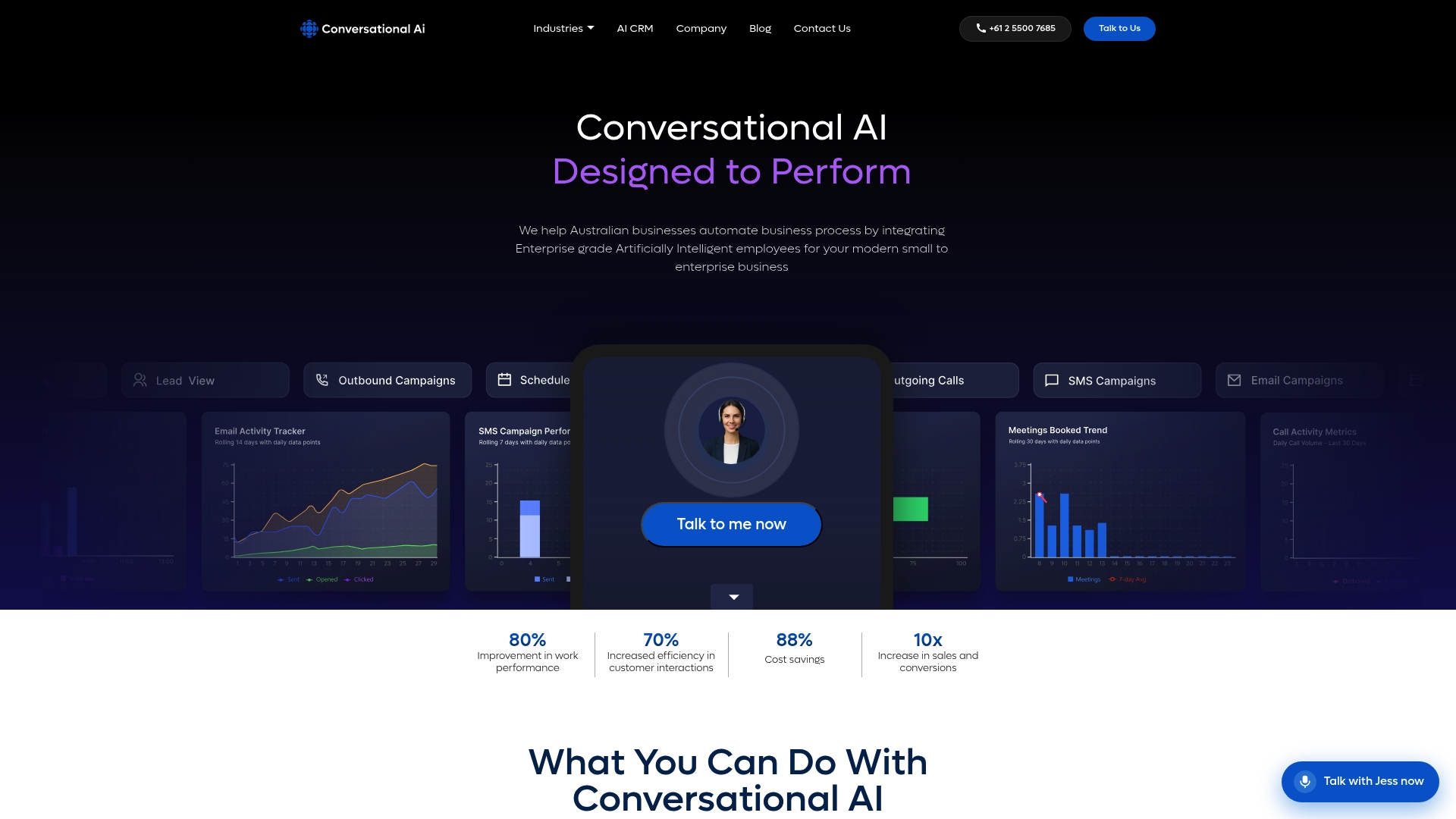
If your shortlist so far has been hyperscaler regions with add-on controls, the private cloud route through Conversational AI’s CRM or its dedicated on-premises deployment option gives you a more direct path to sovereignty without stitching together key management and region locks yourself. Teams in banking and finance or healthcare with strict data residency requirements typically start with a scoped proof of concept against one workflow, such as call transcription onshore for a single customer service line, before expanding. Book a compliance review through the Conversational AI homepage to see what a pilot looks like for your data-tiering plan.
Where to verify this further
Check the OAIC’s guidance on APP 8 directly, review APRA’s outsourcing standards for your sector, and read Conversational AI’s breakdown of the 12 questions compliance officers should ask before signing with any provider.
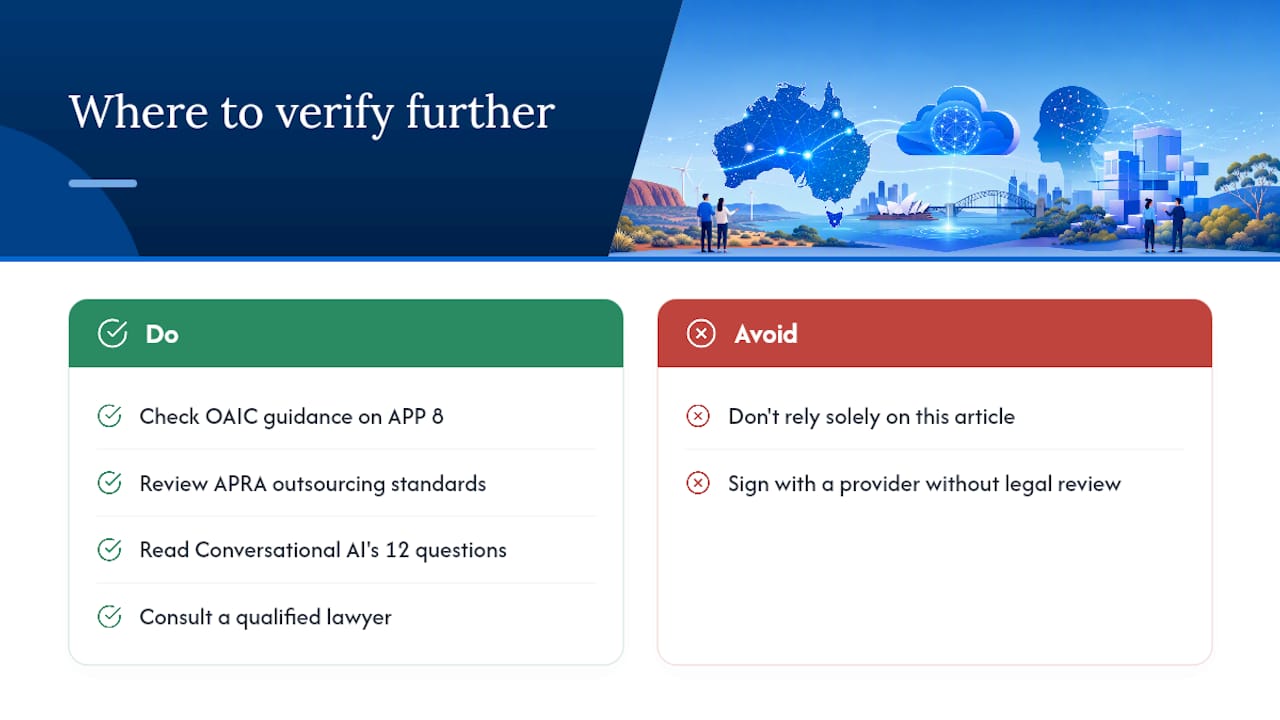
This article is general information, not a substitute for advice from a qualified lawyer. Consult a qualified legal professional about your own circumstances before acting on anything here.
Sources
- APP 8 — Cross‑border disclosure of personal information (OAIC)
- Data sovereignty: essential legal insights for Australian businesses - Sprintlaw
- Sovereign Cloud and Local Data Hosting: Why Australian Businesses Can No Longer Afford to Ignore It - Otto IT
FAQ
Is Australian data residency the same as data sovereignty?
No. Residency means data sits physically in Australia; sovereignty means the provider’s ownership and governing law are also Australian, so foreign parent-company laws can’t compel access even when the servers are local.
Does Australian law require all conversational AI data to stay onshore?
There’s no blanket legal requirement, but APP 8 and sector rules make onshore hosting the practical choice for regulated industries handling personal or health information.
What’s the safest hosting model for call recordings and transcripts?
Sovereign private cloud or on-premises deployment offers the strongest control over recordings and transcripts, since it keeps ingestion, inference, and storage under Australian jurisdiction end to end.
Can I run some conversational AI workloads on public cloud and others on private infrastructure?
Yes, and most enterprises do exactly this: a data-tiering approach keeps PII-heavy interactions on sovereign infrastructure while routing lower-risk, non-identifying conversations through a certified enterprise cloud tier.
How much does Conversational AI’s platform cost?
Pricing for Conversational AI’s Voice AI Agents, CRM, and on-premises deployment options is available on request through the Conversational AI website, where you can request a scoped quote for your workload.