Cut Live Calls 30–50% with AI Call Deflection Hosted in Australia
Cut live call volume up to 50% while keeping resolution. Practical plan for AI agents hosted in Australia with context handoff and containment.

AI call deflection resolves a customer’s issue through automation before it reaches a live agent, using voice AI, chat, or self-service tools instead of a queue. Done properly, it lowers live-call volume while holding resolution steady or improving it, because the system is grounded in real data and hands off context cleanly. Done poorly, it just hides demand. Success depends on CRM access, proper context handoff, and measuring what actually got resolved, not just what got avoided.
TL;DR:
- Proper AI call deflection depends on resolving issues without further recontact, not just delaying or rerouting calls.
- Successful deflection requires CRM integration, full context sharing, and accurate measurement of actual resolutions and recontacts.
- Effective use cases include order status, appointment booking, and simple billing checks, but complex or high-stakes issues should be escalated swiftly.
- Common failures involve phantom resolution, scope creep into complex issues, and broken handoffs due to limited data access.
- Pilot programs should start narrowly, with clear control groups, predefined success criteria, and thorough integration checks to ensure long-term viability.
Table of Contents
- What is AI call deflection, really?
- How AI agents change what’s deflectable
- What channels and systems does reliable deflection need?
- How do you measure whether deflection is working?
- Where does deflection usually go wrong?
- How do you build and roll out a deflection pilot?
- Where does AI call deflection actually work well?
- Why context and data sovereignty decide whether deflection actually sticks
- Ready to pilot AI call deflection that actually holds up?
- Sources
What is AI call deflection, really?
Call deflection succeeds only when the contact is resolved, not merely delayed or relocated. A customer asking “where’s my order?” who gets a correct tracking update from a chatbot has been deflected. A customer who gets a canned “check our website” response and calls back an hour later hasn’t been deflected. They’ve been bounced.
Here’s the arithmetic that separates the two. Say a contact centre fields a large number of calls each month and routes a portion of them to a chatbot. If most of those resolve without a callback, that’s genuine deflection. If many customers ring back within 48 hours because the bot couldn’t act on their account, the “deflected” figure is misleading. That’s phantom resolution, and it’s the single biggest trap in this field.
The scale of the opportunity is real. Recent Australian contact-centre analysis finds 30 to 50% of total contact volume can shift to self-service, with advanced AI agents pushing that ceiling higher by handling multi-step queries older systems couldn’t touch.
- Resolved: the issue is closed, no live agent required, no recontact.
- Deferred: the customer gets partial information and returns to the queue anyway.
- Rerouted: the contact moves channel but still needs a human eventually.
How AI agents change what’s deflectable
Legacy IVR trees ask you to press 1 for billing and hope you picked the right branch. Modern AI agents work differently because they combine natural language understanding with contextual memory, which means a customer can describe their problem in plain language and the system remembers what was said three exchanges ago without asking again.
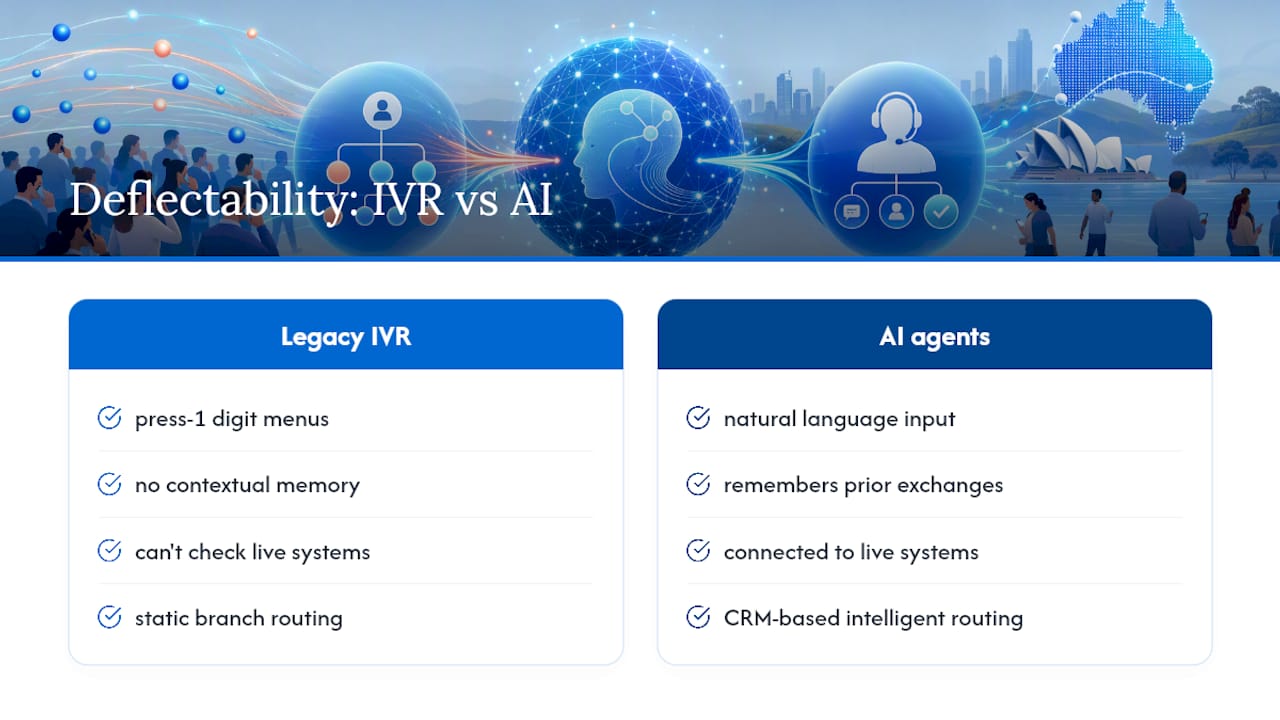
The bigger shift is grounding. An AI agent connected to live systems can actually check an order status, update a delivery address, or confirm an appointment time rather than just describing where to look. That’s the line between a chatbot that answers questions and one that closes tickets. Intelligent call routing built on CRM data pushes this further by matching the right resource to the right query the moment it can’t be resolved automatically, rather than dropping the customer into the next available slot.
Multi-channel persistence matters just as much. A customer who starts on chat and later calls should never have to re-explain the issue. Case studies show AI agents handling predictable, high-volume contacts reliably, provided they escalate with full context when a query exceeds their scope.
Pro Tip: Test escalation quality before you test deflection rate. A system that deflects well but escalates badly will cost you more in repeat contacts and CSAT damage than it saves in agent hours.
What channels and systems does reliable deflection need?
Deflection lives or dies on the plumbing behind it, not just the customer-facing channel. You need front-end touchpoints and a back-end architecture that actually talks to each other.
Front-end channels typically include:
- Interactive voice agents (IVA) replacing or augmenting traditional IVR trees
- AI voice agents handling natural-language phone conversations
- Chat and SMS for text-based self-service
- Knowledge bases surfaced proactively inside those channels
None of that works without the back end. You need CRM integration so the AI agent can read and write account data, an orchestration layer that decides which channel or agent handles a given intent, APIs connecting booking or billing systems, and conversation logging that feeds analytics. Intelligent routing sits alongside a traditional ACD rather than replacing it, adding a layer of intent and CRM data on top of simple “next available agent” logic. Our guide to voice agent integration covers the telephony side of this in more depth.
How do you measure whether deflection is working?
Deflection rate is the headline number, but it lies to you if you track it alone. The formula is simple: deflected contacts divided by total contacts, multiplied by 100. If a sizable fraction of monthly contacts get handled by automation, that constitutes the deflection rate.
The number that matters more is containment: deflected contacts that don’t recontact within a set window, usually 24 to 72 hours. Run both alongside these four:
- CSAT on deflected interactions specifically, not blended across the whole centre.
- Repeat-contact rate, the clearest signal of phantom resolution.
- First-contact resolution (FCR) for contacts that do escalate.
- Average speed of answer (ASA) for the calls still reaching a human.
This matters because Gartner’s research found only a small share of customer-service issues are fully resolved in self-service across the industry, well below what raw deflection numbers usually imply. Pairing deflection rate with containment and CSAT is the only way to tell genuine automation from a customer being quietly bounced.
Where does deflection usually go wrong?
Most failures trace back to one of three root causes, and all three are preventable if you catch them early.
- Phantom resolution: deflection rate climbs while repeat-contact rate climbs alongside it. Watch both metrics on the same dashboard, not in separate reports, or you’ll miss the correlation entirely.
- Broken handoff: the AI collects information the agent can’t see, so the customer repeats everything. A common cause here is enabling AI in the IVR without CRM read/write access, meaning the assistant can gather data but never act on it, which pushes total workload up rather than down.
How do you build and roll out a deflection pilot?
Start narrow. Trying to deflect every contact type at once is how programmes fail publicly and get shut down before they prove value.
- Pick candidate contact types based on three filters: high volume, predictable structure, and clean data access. Order status, appointment confirmations, and account balance checks tick all three.
- Design the pilot with a control group. Best practice is comparing your pilot cohort against a matched control for 30 days, tracking containment, CSAT, and recontact rate side by side.
- Set expansion criteria before launch, not after. Containment must meet or beat baseline, and CSAT must be non-inferior, before you add a second contact type.
- Build the integration checklist: CRM read/write access, transcript logging, a defined escalation path with full context transfer, and a named governance owner reviewing weekly.
Pro Tip: Write your rollback plan before you write your success criteria. If containment drops below baseline in week two, you need a pre-agreed trigger to pause and diagnose, not a debate about whether the numbers are “close enough”.
Teams migrating from older IVR platforms often underestimate this step; our legacy migration guide walks through the data-mapping work that catches most surprises before launch.
Where does AI call deflection actually work well?
The pattern across successful deployments is consistent: high volume, low ambiguity, clear data source.
- Retail order and shipment status deflects cleanly because the answer lives in one system and rarely requires judgement.
- Appointment booking and confirmations in professional services and health work well when the AI agent can read and write to the scheduling system directly, not just describe availability.
- Account balance and simple billing checks deflect reliably, but set a firm escalation threshold the moment a dispute or an unusual charge appears. That’s where automation should hand off immediately, not attempt a workaround.
Why context and data sovereignty decide whether deflection actually sticks
The programmes that hold up under scrutiny share one trait: context travels with the customer. Passing transcripts, intent, and a CRM snapshot at handoff is what stops a resolved contact from becoming a frustrated recontact.
For regulated sectors especially, where the AI platform is hosted isn’t a footnote, it’s a decision factor. An Australia-hosted platform with contextual memory and real-time analytics built in gives operations teams the visibility to catch phantom resolution before it shows up in a quarterly CSAT dip. Before your next pilot conversation, get your contact-type shortlist and metric baseline in front of IT, compliance, and CX leadership together.
— Sowrabh
Ready to pilot AI call deflection that actually holds up?
Conversational AI gives operations teams a genuine alternative to bolting a chatbot onto an IVR and hoping it holds: multichannel AI agents for voice, SMS, email, and live chat, all built on contextual memory and CRM integration, hosted entirely within Australia for data sovereignty.
Before your first conversation with us, pull together your candidate contact types (order status, bookings, balance checks are the usual starting point), your current containment and CSAT baseline, and whoever owns escalation governance internally. That’s the groundwork a real pilot needs, and it’s exactly what we’ll build the integration plan around. If you’re weighing appointment-booking automation specifically, this practical breakdown is worth a look alongside your own numbers.
Book a platform walkthrough and bring your contact-type shortlist. We’ll map it against your existing CRM and tell you honestly whether deflection will hold containment or just move the queue.
Sources
- 2026 Australian contact-centre best practice report
- Intelligent call routing: benefits & how it works | Salesforce
- Gartner survey on self-service resolution rates
- Call deflection: what it is, how to measure it and improve it with AI | Invent